Recently I was asked to check the name for Brazilian rosewood, which is usually listed as having the scientific name Aniba rosaedora or Aniba rosaeodora. It is a famous tree from the Brazilian Amazon, and it is harvested to produce rosewood oil, a large export product. Today it is an endangered species and it belongs to the Lauraceae family (same family as bayleaf, sassafras and avocado). Some more Latin name digging turned up one more alternative name, Aniba rosidora. Ducke, a botanist that worked in the Amazon, described this species in 1928 as Aniba rosaeodora.
What is going on here, and how can so many spellings be in use? I'll got help sorting this out by a very helpful International Plant Names Index (IPNI) editor, and in the end it turns out that both of the names above are incorrect. So here comes a quick crash course in some of botanical Latin grammar rules, so hold on...
The species epithet (the last part of the species name) is in this case made up from two terms:
Rosa odora
Rosa means rose in Latin, and odora means smell. So the meaning of the name is 'smells like a rose'.
Rule 1: Every Latin term has a stem and case ending. In "Rosa", "Ros-" is the stem, and "-a" is the feminine nominative case ending. In a compound epithet (like here), we use the stem of the first term and drop its case ending; we then add the whole of the 2nd term.
Rule 2: When you add two words together like this, sometimes, but not always, you need to add a connecting vowel between the two words.
Rule 3: If the 2nd term starts with a consonant, then a connecting vowel is needed. If the 2nd term starts with a vowel, then no connecting vowel is needed. For Latin words, the connecting vowel is "i". For Greek words, the connecting vowel is "o".
In this case, the 2nd term starts with a vowel, so no connecting vowel is needed, and you get:
Rosa + odora = ros- + odora = rosodora
When this species was first described, these rules were not followed (Latin is not easy!), and a misspelling of the species name has been used everywhere since then.
When you correct a mistake like this, really a typo, you don't need to redescribe a species, you just correct the name, and everything else stays the same. The original author still gets all the credit. This was just corrected in IPNI last week, so in most places online and in most books the old spelling is still used. It will take some time to get this updated in Wikipedia, and on other similar websites.
CORRECT NAME is: Aniba rosodora
INCORRECT NAMES are: Aniba rosaedora, Aniba rosaeodora, and Aniba rosidora.

Welcome to the "Better Botanical Business Bureau", where botanical mistakes in commercial and public venues and products are showcased and corrected. It is not unusual with products, ingredients, and images used in media, design, and commercial works to be presented with the wrong common names, wrong species names, and/or wrong ingredients. This blog provides scientific and educational information to correct such mistakes as part of a global effort to increase botanical knowledge.
Monday, November 24, 2014
Tuesday, November 18, 2014
Fungi this and fungi that, fungi known and fungi what?
All food products have to be marked with their ingredients, but it becomes a little complicated when what is in the packet of dried mushrooms you have just bought turns out to be three unnamed porcini species. Bryn Dentinger and Laura Suz from the Jodrell Lab at Royal
Botanic Gardens, Kew (in United Kingdom) describe how they figured this
out using modern molecular evolutionary methods in a recent paper in
the journal PeerJ. (Here is a link to their research paper.)
So, how could this happen, and how common is this? We have described a lot of species on Earth, especially among plants. But there are some organismal groups that are large uncharted areas on our biodiversity maps where not much is known, and fungi, bacteria, and insects are among those groups. If you are looking for a career focused on new species descriptions, I recommend those groups, and maybe also other invertebrate groups and smaller algae. There is a lot to find out!
Dentinger and Suz explain fungal discoveries:
Can the same thing happen when you buy a bag of dried food plants? Yes, it could, but it is probably less likely because we know more about the plant species of the world.
Reference: Dentinger and Suz (2014), What’s for dinner? Undescribed species of porcini in a commercial packet. PeerJ 2:e570; DOI 10.7717/peerj.570
PS. So, truth to be told, fungi are not actually plants, but fungi have historically been included in botany since they also are sessile organisms stuck in the ground on land (usually, but not always). In reality fungi are actually more close evolutionary speaking to animals than to plants. So, mushrooms are more closely related to bacon, than to potatoes and bamboo shoots. Vegetarians might want to consider that. :)
Thanks to our blog reader EC for sending me the link to this interesting paper.
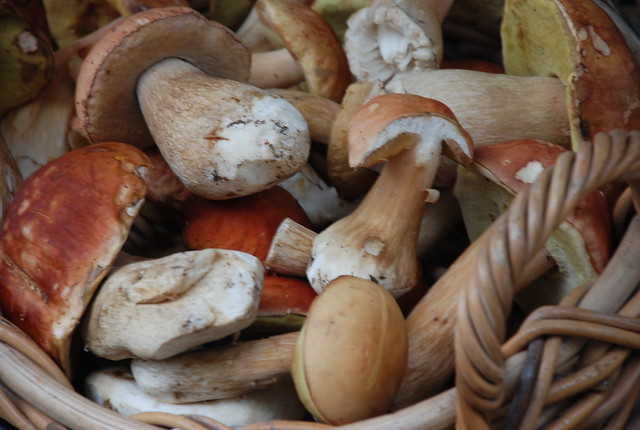 |
| Porcini mushrooms for sale. Photo by Kristen Taylor (Creative Commons license, link) |
So, how could this happen, and how common is this? We have described a lot of species on Earth, especially among plants. But there are some organismal groups that are large uncharted areas on our biodiversity maps where not much is known, and fungi, bacteria, and insects are among those groups. If you are looking for a career focused on new species descriptions, I recommend those groups, and maybe also other invertebrate groups and smaller algae. There is a lot to find out!
Dentinger and Suz explain fungal discoveries:
"Although taxonomists regard new fungal taxa as commonplace, they are often of little apparent consequence to human society and largely go unnoticed by the public. Like all groups of organisms, our knowledge of fungal diversity is biased towards taxa of greatest concern to ourselves, such as edible fungi. For example, wild mushrooms collected and sold as food around the world generally belong to a handful of well-known taxa (e.g., truffles and chanterelles), most of which have long histories of use in European cuisine. However, even some of these well-known groups have been shown to contain underappreciated levels of diversity. "How did the researchers figure out that the package of Chinese porcini a friend of theirs had bought in London and brought to them as a dinner item had new species in it? Porcini belong to the Boletus genus, which include some incredibly delicious species, as well as some you definitely should not eat. I assume they got curious about the brown fungal bits in the bag, and decided to check it out. They took their samples to their molecular phylogenetics lab, extracted the DNA from individual pieces, and then compared those DNA sequences with all known porcini mushrooms' DNA. It turned out that the DNA sequences were different enough to warrant the first description of three new species from China. These new porcini species were named after Chinese common words: Boletus bainiugan, Boletus meiweiniuganjun, and Boletus shiyong (link to description article here).
Can the same thing happen when you buy a bag of dried food plants? Yes, it could, but it is probably less likely because we know more about the plant species of the world.
Reference: Dentinger and Suz (2014), What’s for dinner? Undescribed species of porcini in a commercial packet. PeerJ 2:e570; DOI 10.7717/peerj.570
PS. So, truth to be told, fungi are not actually plants, but fungi have historically been included in botany since they also are sessile organisms stuck in the ground on land (usually, but not always). In reality fungi are actually more close evolutionary speaking to animals than to plants. So, mushrooms are more closely related to bacon, than to potatoes and bamboo shoots. Vegetarians might want to consider that. :)
Thanks to our blog reader EC for sending me the link to this interesting paper.


Monday, November 10, 2014
Mixed herbs - a trip out in the botanical unknown
 |
| Baraka Mixed Herbs. (c) BotanicalAccuracy.com |
A few days ago I found a very interesting bag of plant materials for sale in the local food market - a bag with dried plants marked MIXED herbs. It might be a herbal tea, a spice mixture, I am not sure. Looking closer I was wondering what the actual ingredients were, and looked for the ingredient label.
 |
| Baraka Mixed Herbs. (c) BotanicalAccuracy.com |
 |
| Baraka Mixed Herbs Nutrition Facts and Ingredient List. (c) BotanicalAccuracy.com |
Wednesday, October 29, 2014
Red berry, blue berry... cranberry, lingonberry?
In Scandinavia many forest berries are wild-harvested and then used for home canning of jams and sauces, and also sold commercially to companies to flavor drinks, juices, yogurt, desserts, jams, and so on. Many of these are members of the Vaccinium genus in the blueberry family (Ericaceae).
One of the most common ones is lingonberry (Vaccinium vitis-idaea), a low-growing blueberry relative with small, red, shiny, and clustered berries on short upright stalks and with leathery oblong leaves. They look like little tiny bushes sticking out of the soil among mosses and lichens in the taiga forests. Lingonberries are a very Swedish thing, and served with classic pancakes, blood pudding (maybe not so common anymore, but served in public school when I grew up in Sweden), and traditional cheese cake. It is an incredibly well-known and common wild-foraged plant in Scandinavia.
Common names are not regulated, they are just used by people as they see fit over the world. This species is called lingonberry in English most of Europe and North America, cowberry in parts of North America, and lowbush cranberry in Alaska. Other names are wortleberry and mountain cranberry. Which leads to giant confusion with the cranberry species below when you only use common names.
Other Vaccinium species also has red delicious berries, and among the most well known in the Northern hemisphere are the cranberries. In Europe it is mostly the cranberry species Vaccinium oxycoccus, and in North American cranberry the larger-fruited Vaccinium macrocarpon. Cranberries grow mostly on the surface of the peat moss in bogs. They have lonely berries on long thin stalks that are laying on the ground, and long creeping branches with small leaves. They are not grown commercially in Scandinavia, but are cultivated in other parts of the world. Their tart flavor means that they are often used for jelly to be served with meat, and also for cranberry juice.
Cranberries and lingonberries are very different-looking plants when you see them side by side, but despite their large morphological differences there are common mistake. As usual the stock photo market is among the worst, and here are an abundance of cranberry photos that actually show lingonberry (the opposite is much less common, so people seem to know how lingonberry looks like, but not how cranberries do). However, if the photos are from Alaska, they might be correct if they meant the low-bush cranberry(=lingonberry/cowberry), but there is no way of knowing if they use the Alaskan meaning of cranberry, or if they made a plant identification mistake (that is why we have scientific names to keep things in order) . Here are some examples of 'cranberry' photos featuring lingonberry (Vaccinium vitis-idaea):
To further confuse the American public, there is also 'cranberry bush' or tree, which is a species in the unrelated genus Viburnum and have nothing do to with Vaccinium's. But that will be a different story.
So, to summarize how to tell these species apart in a photo:
Lingonberry, cowberry, lowbush cranberry (Vaccinium vitis-idaea): short plant with upright stems in forest, leaves leathery and oblong, often slightly curled at edges, berries clustered together
Cranberry (several species of Vaccinium, such as V. macrocarpon and V. oxycoccus): creeping plant on bogs, with long thin branches, leaves smaller, berries along on long thin fruit stalks
 |
| lingonberry, also called cowberry, Vaccinium vitis-idaea Public domain photo from Lindman's Bilder ur Nordens Flora |
Common names are not regulated, they are just used by people as they see fit over the world. This species is called lingonberry in English most of Europe and North America, cowberry in parts of North America, and lowbush cranberry in Alaska. Other names are wortleberry and mountain cranberry. Which leads to giant confusion with the cranberry species below when you only use common names.
 |
| (European) cranberry, Vaccinium oxycoccus Public domain photo from Lindman's Bilder ur Nordens Flora |
Other Vaccinium species also has red delicious berries, and among the most well known in the Northern hemisphere are the cranberries. In Europe it is mostly the cranberry species Vaccinium oxycoccus, and in North American cranberry the larger-fruited Vaccinium macrocarpon. Cranberries grow mostly on the surface of the peat moss in bogs. They have lonely berries on long thin stalks that are laying on the ground, and long creeping branches with small leaves. They are not grown commercially in Scandinavia, but are cultivated in other parts of the world. Their tart flavor means that they are often used for jelly to be served with meat, and also for cranberry juice.
Cranberries and lingonberries are very different-looking plants when you see them side by side, but despite their large morphological differences there are common mistake. As usual the stock photo market is among the worst, and here are an abundance of cranberry photos that actually show lingonberry (the opposite is much less common, so people seem to know how lingonberry looks like, but not how cranberries do). However, if the photos are from Alaska, they might be correct if they meant the low-bush cranberry(=lingonberry/cowberry), but there is no way of knowing if they use the Alaskan meaning of cranberry, or if they made a plant identification mistake (that is why we have scientific names to keep things in order) . Here are some examples of 'cranberry' photos featuring lingonberry (Vaccinium vitis-idaea):
 |
| Herbal Extracts Plus website, showing lingonberry images on the cranberry page. Screenshot by BotanicalAccuracy.com. |
 |
| Dreamstime stock photo website, showing a cranberry image for sale, that actually shows lingonberry. Screenshot by BotanicalAccuracy.com. |
 | |
| Botanic Innovations LLC website, showing a lingonberry photo on the page for Cranberry seed oil. Screenshot by BotanicalAccuracy.com. |
 |
| Seeds-Gallery website, showing a lingonberry photo on the page for American Cranberry seeds. In this case we know what species they mean since they give the scientific name Vaccinium macrocarpon, and that is Vaccinium vitis-idaea on the photo. Screenshot by BotanicalAccuracy.com. |
 |
| Stockphoto for sale on CanStock website, showing a lingonberry photo marked as 'tranbär' (cranberry). Screenshot by BotanicalAccuracy.com. |
The problem is that many companies buy stock photos to illustrate websites and newsletters and commercial packaging, and that there is no taxonomic quality control nor scientific species names on the labeling of stock photos. Many companies appears to be unaware of that they are using the wrong species in their materials until someone points it out, and by then they have inadvertently provided false marketing and information by using inaccurately named images. Here is a packaging example of cranberry herbal tea, showing lingonberries and cranberries on the box:
 |
| Caribbean Dreams Cranberry Herbal tea, showing branches of lingonberries, not cranberries, but with a cranberry bog in the background, and cranberries along the edge. |
So, to summarize how to tell these species apart in a photo:
Lingonberry, cowberry, lowbush cranberry (Vaccinium vitis-idaea): short plant with upright stems in forest, leaves leathery and oblong, often slightly curled at edges, berries clustered together
Cranberry (several species of Vaccinium, such as V. macrocarpon and V. oxycoccus): creeping plant on bogs, with long thin branches, leaves smaller, berries along on long thin fruit stalks
Saturday, October 18, 2014
Chamomile, what flower is on your tea box?
What do you think - does this chamomile tea box from STASH show chamomile flowers or something else?
 The medicinal plant chamomile has been used since ancient times for medicinal uses, especially as a calming and sleep inducing tea. Chamomile is usually one of two similar-looking species, Roman chamomile (Chamaemelum nobile) or the more common German or wild chamomile (Matricaria chamomilla). These species have many common names and also many scientific synonymous names, so I am listing some of them below.
So, what is the problem? Well, there are many species in the sunflower family that look like white daisies with a yellow center, like both of the chamomiles have. So the companies that make chamomile tea packaging seems to have a horrible time putting the right species on the box. Even worse is the stock photo market where a lot of 'chamomile tea' photos show something totally different than one of the two chamomile species.
Why does this matter? Even if plants are similar in shape and color, they can have different chemistry. Many times an edible plant may have a toxic look-alike. If companies can't even bother putting the right plant on the label, can you trust them to check what is really in that bulk sample of dried leaves and flowers they are selling and want you to steep and drink and then sleep calmly on? Maybe not...
So, how does the two true chamomile species look like? First, the 'flower' of a chamomile is a whole flower head. It is a member of the sunflower family, Asteraceae, and just like its relative the sunflower in each flower head there is a circle of outer small ray flowers (white), and in the flat center is an area of disk flowers (yellow) that look like small yellow tubes.
Here is German chamomile (Matricaria chamomilla, some older names are Chamomilla chamomilla, Chamomilla recutita, Matricaria recutita and Matricaria suaveolens):
The Roman chamomile also have finely dissected leaves and a central part of the flower head that is lifted up.
The most common mixup when it comes to photos and other illustrations of chamomile is with the oxeye daisy, Leucanthemum vulgare. It has very different leaves that are whole and with a serrate edge. The flower heads are flatter and the ray flowers are a lot larger and longer. This species is also often unbranched or just branched from the base, but Roman and German chamomile are often very much branched.
The easiest way to tell these species apart is to look at the flowers in the flower head and the leaf shape - here is an overview of the good characters to tell them all apart:
So, who got it wrong and needs to fix their packaging illustrations?
Do any teaboxes show the right chamomile?
And then we have the world of stock photo inaccuracies, which seems to be a never-ending subject. The lack of quality control of stock photos is rather astounding.

And then we have the mystery plant. On Tom's of Maine's toothpaste 'Botanically Bright, with natural chamomile', there is a flower head that is not chamomile, but something else in Asteraceae, and leaves that are neither chamomile, fleabane, nor oxeye daisy. I wonder what it might be...
The medicinal plant chamomile has been used since ancient times for medicinal uses, especially as a calming and sleep inducing tea. Chamomile is usually one of two similar-looking species, Roman chamomile (Chamaemelum nobile) or the more common German or wild chamomile (Matricaria chamomilla). These species have many common names and also many scientific synonymous names, so I am listing some of them below.So, what is the problem? Well, there are many species in the sunflower family that look like white daisies with a yellow center, like both of the chamomiles have. So the companies that make chamomile tea packaging seems to have a horrible time putting the right species on the box. Even worse is the stock photo market where a lot of 'chamomile tea' photos show something totally different than one of the two chamomile species.
Why does this matter? Even if plants are similar in shape and color, they can have different chemistry. Many times an edible plant may have a toxic look-alike. If companies can't even bother putting the right plant on the label, can you trust them to check what is really in that bulk sample of dried leaves and flowers they are selling and want you to steep and drink and then sleep calmly on? Maybe not...
So, how does the two true chamomile species look like? First, the 'flower' of a chamomile is a whole flower head. It is a member of the sunflower family, Asteraceae, and just like its relative the sunflower in each flower head there is a circle of outer small ray flowers (white), and in the flat center is an area of disk flowers (yellow) that look like small yellow tubes.
Here is German chamomile (Matricaria chamomilla, some older names are Chamomilla chamomilla, Chamomilla recutita, Matricaria recutita and Matricaria suaveolens):
%2Bwikipedia.JPG) | ||
| German chamomile. Photo by |

 |
| German chamomile, in Köhler's Medizinal-Pflanzen on Wikimedia, public domain. |
Note how the leaves of German chamomile are divided into many narrow segments, and how the flower head is hollow and uplifted in the center with age, and how the white ray flowers along edge becomes vertically pointed downwards with age.
Here is Roman chamomile (Chamaemelum nobile), a very similar species that previously has been called Anthemis nobilis.
 |
| Roman chamomile, in Köhler's Medizinal-Pflanzen on Wikimedia, public domain. |
The most common mixup when it comes to photos and other illustrations of chamomile is with the oxeye daisy, Leucanthemum vulgare. It has very different leaves that are whole and with a serrate edge. The flower heads are flatter and the ray flowers are a lot larger and longer. This species is also often unbranched or just branched from the base, but Roman and German chamomile are often very much branched.
 |
| Ox-eye daisy, from Lindman's flora, now in the public domain. |
Fleabane is another species you see mixed up with chamomile sometimes. It has many, many more ray flowers and each white ray is a lot narrower than a chamomile or ox-eye daisy.
 |
| Fleabane, Erigeron annuus, with a branched inflorescence, whole leaves, and flower heads with many, many white ray flowers. Photo by Enrico Blasutto on Wikimedia, Creative Commons license. |

Common name
|
German chamomile
|
Roman chamomile
|
oxeye daisy
|
fleabane
|
Accepted
name
|
Matricaria chamomilla
|
Chamaemelum nobile
|
Leucanthemum vulgare
|
Erigeron sp.
|
Older
names
|
Matricaria
recutita
|
Anthemis nobilis
|
Chrysanthemum leucanthemum
|
Erigeron annuus and E. strigosus are common species)
|
Leaf
type on stem
|
finely dissected into small, long narrow lobes, fern-like
|
finely dissected into small, long narrow lobes, fern-like
|
simple, whole leaves wider towards the apex, edges with
irregular teeth, leaves clasping stem
|
whole, lance-shaped to oblong, with serrate edge
|
Flower
heads per plant
|
ca. 8–120 per plant, stem heavily branched
|
ca. 3-20 per plant, branches many
|
ca. 1-10, branches few and flower heads long-stalked
|
5–50+ per plant, branches many
|
Number
of white ray flowers per head
|
ca. (10-)14-26
|
ca. 13–21
|
ca. 13–34
|
ca. 80–125, very thin and narrow
|
Ray
(white) flowers on old flower heads
|
bending down under the flower head
|
bending down under the flower head
|
spread outwards, horizontal, sometimes downwards (wilted look)
|
spread outwards, horizontal, or coiling upwards
|
Yellow
center in middle of flower head (= all disk flowers)
|
raised like a dome
|
raised like a dome
|
flat or sunken inwards
|
flat or slightly dome-shaped, often slightly sunken in center
|
So, who got it wrong and needs to fix their packaging illustrations?
 | |||
| Royal herbal tea infusions show oxeye daisy on their chamomile tea. |
 |
| Stash's non-organic chamomile tea unfortunately shows a fleabane plant. Flea bane has been used for, you guessed it, remove fleas and other parasites on our bodies and clothes. Photo by BotanicalAccuracy.com. |
Do any teaboxes show the right chamomile?
 |
| Alvita Chamomile tea box with real chamomile on it. |
 |
| Stash's organic chamomile tea shows nice real chamomile on it. |
 |
| Traditional Medicinals also gets it right with their organic Chamomile tea. Here is the right thing. |
And then we have the world of stock photo inaccuracies, which seems to be a never-ending subject. The lack of quality control of stock photos is rather astounding.
 |
| Dreamstime is selling two photos labeled as 'Cup of herbal tea with chamomile flowers'. Sorry, that is ox-eye flowers. Screenshot by BotanicalAccuracy.com. |
And then we have the mystery plant. On Tom's of Maine's toothpaste 'Botanically Bright, with natural chamomile', there is a flower head that is not chamomile, but something else in Asteraceae, and leaves that are neither chamomile, fleabane, nor oxeye daisy. I wonder what it might be...
 |
| Tom's of Maine toothpaste Botanically Bright. Photo by BotanicalAccuracy.com. |
Subscribe to:
Posts (Atom)