Showing posts with label Asia. Show all posts

Monday, November 10, 2014

Mixed herbs - a trip out in the botanical unknown

Baraka Mixed Herbs. (c) BotanicalAccuracy.com
 A few days ago I found a very interesting bag of plant materials for sale in the local food market - a bag with dried plants marked MIXED herbs. It might be a herbal tea, a spice mixture, I am not sure. Looking closer I was wondering what the actual ingredients were, and looked for the ingredient label.  

Baraka Mixed Herbs. (c) BotanicalAccuracy.com
And there is was: "Ingredients: Mixed herbs".  But which ones?  Good ones, tasty ones, toxic ones, allergen ones?  There is no way to know.  The photo shows sage, ox eye daisy (presumably), and a hibiscus, plus a purple-flowered Lamiaceae.  You can find out that the dried plant parts are from Jordan, but not what species they are. Some of the parts look like Hibiscus flowers, but can you be sure?
Baraka Mixed Herbs Nutrition Facts and Ingredient List. (c) BotanicalAccuracy.com
Now, this is of course against any FDA rules when it comes to labeling of foods.  All things that are sold that we eat has to be labeled with exact ingredients and nutrition information. So, here the customers and consumers are kept in the dark... this bag can contain exactly what is says: Mixed herbs of unknown kinds.

Sunday, June 9, 2013

Wikiherbia: Anise is not the same as star anise

The website wikiherbia promotes itself as the 'complete herb database' and provides information on medicinal plants.  It is in no way complete and lists only a little over 100 plants, and doesn't appear to be a very active website.  However, the information is still there, and people will search for information and find this resource, so it is important that the information is as correct as possible.  Unfortunately, there are some grave errors.

Screenshot of Wikiherbia web page on "anise / Pimpinella Anisum", by BotanicalAccuracy.com

The herb anise (Pimpinella anisum) is featured in wikiherbia, but not only is the Latin name wrongly formatted, but the associated image is of another species, star anise (Illicium verum).  The photo on the web page shows the fruit of star anise. The text is fully focused on anise, not star anise.

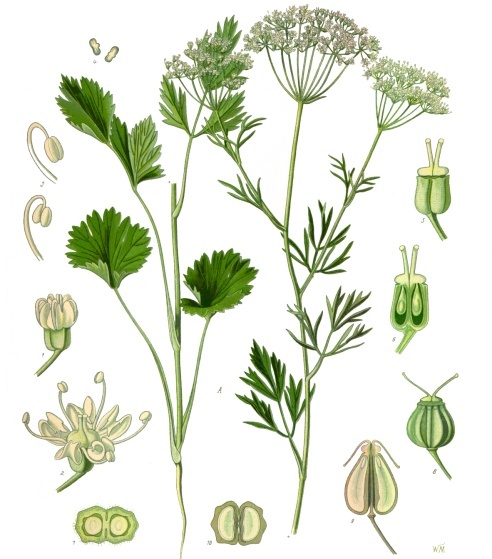
Anise and star anise are unrelated plants with different chemical profiles, with the only similarity being that they both have a compound that gives a taste that is somewhat similar to licorice   Anise is a temperate plant in the parsley family (Apiaceae), and star anise is a subtropical/tropical shrub in the family Schisandraceae.

This is how anise (Pimpinella anisum) looks like 
(it is very similar to cilantro, same group of plants):
anise, Pimpinella anisum
Public domain image, from Köhler (1887), Wikimedia


And here is star anise:
star anise, Illicium verum
Public domain image, from Köhler (1897), Wikimedia

Star anise is used for the commercial production of the anti-viral medicine Tamiflu and in Asian cooking, whereas anise is mostly used in European cooking and herbal medicine.

Saturday, May 18, 2013

Greening Singapore with temperate weeds?

2013 logo for Singapore's National Park Service
© Singapore National Parks, fair use.

I recently recieved an e-mail from Singapore and this nice logo above was attached to the e-mail.  It celebrates 50 years of Greening Singapore by their National Parks service.  I have never been to Singapore, but I have heard and read about its fantastic tropical flora and fauna, and how this country supports environmental sustainability.

The issue here are the flowers in the logo.  The trees appear to be tropical trees, but the nice wildflowers in the foreground appears to be mostly temperate weeds.  Maybe these are common in Singapore as well, but wouldn't you have wanted to highlight tropical flowers such as orchids, hibiscus, or maybe even some nice native wildflowers. Singapore is nearly on the equator, so about as far away you can get from our temperate flora and seasons.

The wildflowers in question appear to be (from left to right):


Close-up of logo above.
A thistle? (Cirsium?, Asteraceae) {also known as a common weed}
A hawkweed or dandelion? (Taraxacum, Crepis, Hieracium?, Asteraceae) {another weed}
An oxeeye daisy? (Leucanthemum vulgare, Asteraceae)

 and...
Close-up of logo above.
a blue bell (Campanula, Campanulaceae)

These would be the kind of flowers you find in (well, maybe outside...) London, for example, and they are typical of temperate areas.  I can't help wonder if the company that designed the logo just went online and picked any pretty flowers they could find, or sent out the work order to a designer without thinking about what plants that would be appropriate for this particular place. Of course there is artistic freedom, but in this case, the logo is supposed to celebrate the work of making Singapore a more green tropical city. 

If any Singaporean botanists read this, please let me know what you think, because I would love to have your feedback on this.