Showing posts with label illustration. Show all posts

Monday, January 20, 2014

Beware of the wronged coconuts

Coconut palms are the quintessential symbol of tropical paradise. Spindly, tall trees with large feathery leaves wisp in tropical breezes on tropical beaches of white sand, under blue sky and by turquoise water.

beach
Beach in Hawaii with coconut palm tree.
(cc) anda (: on Flickr.

Up in the crown of the palm, a few coconuts are usually hanging, ready to fall down on you at any moment.  If they do, and they don't hit you, with some work you can get to the delicious inside of the coconut. (As a side note, when you consume the white parts inside, you eat or drink palm endosperm. In case you didn't know. )

This staple food plant is spread all over the tropics, and a well-known plant in many cultures, even urban cities of today far from tropical beaches.  It is a plant that is easy to identify, delicious, and quite symbolic for us.  Therefore, it is quite strange that in popular culture so many illustrators get this plant wrong.  Really wrong. OK, as an illustrator you can simplify a lot, that is fine, but that is not the same as changing the properties of a plant and create something that doesn't exist.

First, this is how a coconut plant looks like:

Coconut palm, Cocos nucifera (Arecaceae)
From Köhler's Medicinal-Pflanzen, public domain (Wikipedia)
  • Note the tall, skinny stem of even thickness, with horizontal leaf scars on it.
  • Note the big fruits (coconuts), aggregated close to the trunk at the top.
  • Note the leaves, in a rosette at the top
  • Note that each leaf is divided into tiny, tiny leaflets that are arranged like a feather along a midrib.  It it the midrib, the vein along the center, that holds together the leaf. Each leaf can be very long, up to 5 meters (15 feet) at least and all the little leaflets are loose from each other except at the midrib of the leaf.

Here is a closeup of a coconut leaf, showing many leaflets along a midrib:

Coconut leaves
Coconut leaf showing many leaflets connected along the midrib.
(cc) Azeem Azeez on Flickr.
So, how do some of  the clipart masters and popular illustrators show coconut palms?  

A quick Google search results in a variety of morphologies, most of them correct:
Screenshot of Google image search 'coconut palm clipart free',
(cc) BotanicalAccuracy.com
 but a few hits that look like this:

"Palm Tree Clipart Image: Tropical Coconut Palm Tree Icon"
Image courtesy of pamsclipart.com
Coconut tree design
(cc) SweetClipArt.com
Screenshot from 123RF.com, a stockphoto website showing 'palm clip-art'.
(c) 123RF.com, fair use.
Screenshot of logos.co, showing clipart with 'double coconut palm tree island and sun'.
(c) Hit Toon, fair use.

Do you see the problems here?  Hint - stems and leaves.

Coconut leaves are finely divided into small thin and long segments arranged along a midrib, like a feather.  But, these ones above have whole, undivided leaves, which sometimes are slightly lobed.  In fact, some of these leaves look more like banana leaves.

The stems should be evenly thick, and they should have horizontal, evenly distributed leaf scars towards the top of the tree trunk.  These have a variety of stem patterns and shapes.

One thing they get right, the placement of the coconuts.  But you wonder why are there nearly always three coconuts in a tree, don't you?

So, shouldn't illustrators have the freedom to simplify, improvise, and design their own plants?  Sure.  But if you use one of these examples, then realize that the adults and kids that see these images will think that this is how a coconut palm looks like, when in reality, that is not true.  So, even if these images are fine and pretty as clip art and design pieces, they are still very botanically inaccurate.
Screenshot of Google image search 'dog clipart free',
(cc) BotanicalAccuracy.com
Illustrators often simplify drawings of dogs, elephants and chickens too, but the characteristic features are always there, trunk, wagging tail, 4 legs, beak and feathers,. and so on.  To change the features that are characteristics for the coconut palm changes the species, it changes what you want to illustrate into an imaginary plant. It is like drawing a dog with a beak - we would complain that it no longer was a dog.  Many people don't realize that these palm drawings are incorrect, because we have lost a lot of botanical knowledge in our societies.  We all still know how a dog looks like though!

Saturday, December 28, 2013

Batman and Poison Ivy's leaves

The weeds and botanical inaccuracies have also entered the world of comics. In 1966, Batman had a new nemesis, Poison Ivy, a botanist turned bad. (Brilliant!, says the botanist and author of this blog.) The poison ivy plant is one of the most obnoxious weeds of North America.
Issue 181 of DC comics Batman, introducing Poison Ivy for the first time (1966).
The leaves are very similar to true poison ivy, and definitely not English ivy leaves.
© DC Comics, fair use, Wikipedia.
"Poison Ivy is an enemy of Batman. She is depicted as one of the world's most prominent eco-terrorists. She is obsessed with plants, botany, and environmentalism. She uses toxins from plants and her own bloodstream for her criminal activities, which are usually aimed at protecting the natural environment." 
(link to this quote and more information about Poison Ivy at Batman Wiki)
Poison Ivy is of course named after one of North America's most troublesome weeds, the poison ivy (Toxicodendron radicans) in the family Anacardiaceae, same family as the tasty cashew nut and mango, as well as poison oak and poison sumac. This incredibly common woody plant, which can be a shrub or a liana, can cause absolutely horrible allergic dermatitis (skin reaction) with liquid-filled blisters and sores that can take weeks to heal. I know this first hand; I became allergic after moving to the US.

What is interesting with Batman's Poison Ivy is her leafy coverage, which has changed over the years.  Now, remember, most Americans know how poison ivy looks like, 'leaves in three, leave them be'.  In reality the three 'leaves' all belong to the same leaf, which is divided into three separate leaflets.
Poison ivy, leaves are divided into three separate leaflets,
with the middle leaflet stalked. Do not touch this plant!
Photo by Esculpio, public domain, link


But there is a sort of namesake, English (and Irish) ivy (Hedera helix and H. hibernica), which is an unrelated, non-allergenic European plant that has spread through horticulture across North America.  English ivy has simple leaves with three lobes.  Since the common names are similar, and both have green leaves and are climbing, people confuse these plants.

English ivy, with non-divided but lobed leaves. 
Photo by James H. Miller, USDA Forest Service, public domain, link
The subsequent illustrators of Batman's Poison Ivy girl has not always been able to make the distinction between poison ivy and English ivy, and as a result, there is a lot of confusion, especially among non-DC comics people making illustrations, costumes, and such when it comes to the right leaf to draw or use.   

Now, why is this important?  Well, accessorizing Poison Ivy with the wrong plant is kind of giving Luke Skywalker a sunflower to fight with instead of a lightsaber.  One is powerful and strong, the other is just pretty. We are not talking imaginary futuristic plants here, we are talking about living, existing species.  Nobody would name a character 'Lord Bear' and then let him wear a deer skull on his head, now would they? The same thing should matter for plants, especially toxic plants.


So, lets see who got it right? These are true poison ivy leaves.
1966, with correct leaves on.
(c) DC Comics, fair use, link.


Poison ivy on the cover of Joker's Asylum issue 1, 2008 (by DC Comics).
A little hard to tell on this, but there are three-divided leaves on the brown branch at the bottom
right and the leaves do not look like English Ivy at all.
(c) DC Comics, fair use, link
A closeup of above illustration.
Source, see above.
Poison Ivy in 1981, also with right leaves on.
© DC Comics, fair use, drawn by Irv Novick and Steve Mitchell, link.

And in the last ten years, things started to go wrong.
Here we have sometimes English ivy instead of Poison Ivy.

The leaves are clearly broad and have three lobes, so English ivy it is.
Promotional art for Batman: Gotham Knights vol. 15 (2001). Illustration by Brian Bolland.
Close-up below. © DC Comics, fair use, link.
English ivy, definitely.
(source, see full image above)
English ivy leaves on Poison Ivy.
© DC Comics (DC Universe online), fair use, link.

9
English ivy abounds on Poison Ivy here.
© DC Comics, fair use, link.

If you are going to buy a Poison Ivy Halloween costume (for $300),
do you want it with English ivy leaves?  Here is one of them.
Screenshot from etsy, © darkpony designs, fair use, link.
 And some are just using some generic leaves, of uncertain species identities or are just unclear:

Poison Ivy in a DC comics from 2006, with leaves in her hair. Closeups below.
© DC Comics, fair use, link.
On the upper frame, she appears to have true poison ivy in her hair.
But on the bottom right frame the leaves suddenly have become more lobed. 
This still possibly could be poison ivy, but it is not typical shapes at all. Looks more like English ivy now.
 And, if you want to simplify, just remove all leaves and
then you don't have to worry about species identity:

Poison Ivy in the animated Batman movies.
© DC Comics, fair use, link.

Sunday, December 15, 2013

Christmas Tree of Life does not need a little correction

Christmas Tree of Life Greeting Card
(c) blaghag on Zazzle, fair use.
Here is a cute little Christmas Tree of Life Greeting card designed by 'blaghag' for sale on Zazzle (link) , depicting the evolutionary relationships between reindeer, elves, Santa, and the four plants fir tree, poinsettia, holly and mistletoe, all accurately depicted and with nice scientific names.  Santa and the elves got new fictitious scientific names, nice! The description of the card includes this justification why this is a great card to buy:
"From mistletoe to reindeer, we're all share a common ancestor! Great card to send to your scientific and freethinking friends for the holidays."
I love this card.  It is innovative, fun, and for any science and reason-minded person, a great card.

Phylogenetic trees are read from the root to the tips. In this card, the root (the common ancestor) is at the top, and the branches to the different organisms are branching downwards.  Santa is most closely related to Elves, and reindeers are related to Santa+Elves, since they are all animals, all three of these groups.

Fir trees are conifers, and conifers are part of gymnosperms that are the sister branch/group to flowering plants (such as poinsettia, holly, and mistletoes).  Poinsettia is in the family Euphorbiaceae with spurges and they are placed in a bog group of plants called rosids (near roses, walnuts, birches, and many other plants). Mistletoes are in the family Santalaceae with lots of other parasitic plants, which are placed on another branch, sister to a giant group of plants called asterids.  Holly, an asterid, is in the family Aquifoliaceae. Other asterids are carrots, sunflowers, viburnum, and artichokes, the coffee plant, milkweeds, mint and potatoes.

[This post was updated on January 12, 2014.  The phylogenetic tree shown on the postcard is correct; mistletoes are sisters to holly plants.  The blog text has been changed so it is accurate based on the latest scientific findings. We regret the error. ]

Thursday, December 5, 2013

Canola oil flowers - four or five petals? Ask Trader Joe...


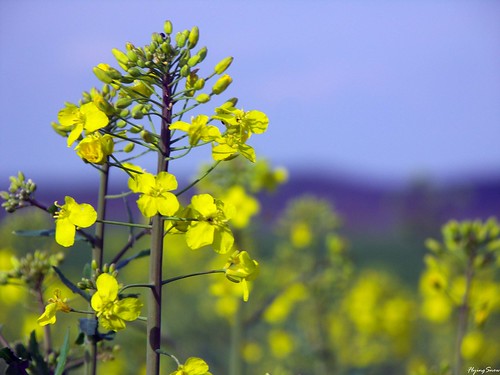
Canola oil is made from the rape seed plant's (several Brassica species) oil rich seeds, a member of the mustard family, the Brassicaceae.  Members of this family can easily be identified by their very typical flowers.  They have 4 petals, often white, yellow, or pink, situated in a cross-wise fashion, which gave them the old family name Cruciferae.  Yes, that is the same word beginning as in crucifix, a cross.

Brassicaceae flowers also have 6 stamens, and a central pistil that will develop into a fruit when/if pollinated.  All mustard plants have the same types of flowers, be it broccoli, garlic mustard, cabbage, arugula, or kohlrabi.  But there is one place, where the rule doesn't hold up...

Canola Oil Spray at Trader Joe's.
(cc) BotanicalAccuracy.com

On the Trader Joe's Canola Oil Spray bottle, sold only at the Trader Joe's supermarket, they have nicely added some flowers from the canola oil plant to the label. Only the flowers look like this:

Close up of Canola Oil Spray cans at Trader Joe's.
(cc) BotanicalAccuracy.com


So, what do we have here?  One flower with four petals (good!), and one flower with five petals (oops!).  And inside each flower, there are three 'things'.   I assume these might be stamens or pistils, but neither makes sense based on the numbers or shapes. The flowers are also never arranged in this particular fashion, but that is a minor point.

So, who cares? Well, if you make a piece of art you certainly can and should have artistic freedom. But, if you illustrate a product, the illustration should provide some knowledge (or excitement) or identification value about the product. It should be the real thing and not introduce errors or misunderstandings into the public's knowledge of plants and the product source.

The number of petals on mustard flowers are strictly determined by that group's bauplan, just like the 4 legs of a dog is based on a strict bauplan among allmammals. You don't go around and see a 5-legged dogs, do you? (5-legged dogs do exist, but are mutants, and they are even rarer in art.)

Here is the real canola:
canola
Flowering canola plant. 
(cc)  Melanie_B (Flying Snow) on Flickr.

So, in this case, the flowers on the label are used to illustrated the origin of a product, canola oil from the canola plant. There are no canola oil flowers with 5 petals. There are no canola oil flowers with 3 non-descript things in the center of the flowers.  If this drawing had been made with 4 petals it would have been equally pretty, and also accurate. So you start to wonder where things went wrong, with the illustrator, with the description to the illustrator, or to the designer of the label?

Tuesday, March 12, 2013

Royal Copenhagen: Flora Danica (example 1)

One of the most expensive china sets in the world, Flora Danica, is produced by the renowned company Royal Copenhagen, and the designs are taken from the historic illustrated works of Flora Danica ('The Flora of Denmark').  For their recent designs, they incorrectly named not one, but two, of the species they have used from the flora illustrations.  Both species are commonly known plants, not rare species.
Source: Royal Copenhagen's 2012 brochure.
The two 2012 designs are also prominently featured in their marketing brochure. Both designs are made by Anja Vang Kragh, a freelance designer. This mistake really surprised me considering the long tradition of excellence in botany in Denmark, and that all illustrations from Flora Danica are available with scientific names.  
The two plates that have the wrong species listed.
Source: Royal Copenhagen's 2012 brochure.
Example 1: The lion's teeth that was a goat's beard

This pattern is listed as 'Dandelion' in the English 2012 catalog, and as 'Mælkebøtte' (the Danish name for dandelion) in the Danish version of the 2012 catalog. Dandelion (Taraxacum officinale) is one of the most common weeds in the northern hemisphere and most everybody can recognize a dandelion. This is how the newly designed china looks like:

'Dandelion' pattern from Royal Copenhagen's Flora Danica series. Image source: Royal Copenhagen.
A quick search through The Kongelig Bibliotek's online Flora Danica illustrations, shows that 'Mælkebøtte' brings you to Taraxacum, just as it should. However, none of the plates are the design used on the plates above.  Instead, the design on the china is most likely from this Flora Danica illustration (see below), with parts removed, the illustration inverted, parts moved and copied in, and so on.

Tragopogon minor, Flora Danica, plate 2838.
Source: http://www.plantgenera.org; Public Domain.
This Flora Danica illustration features Tragopogon minor, a species that now goes under the name Tragopogon pratensis subspecies minor. It is called 'Meadow's salsify' or 'Showy Goat's Beard' in North America (the edible salsify belongs to the genus Scorzonera, also in this family).  It is considered a weed in North America, and it was introduced from Eurasia. It is a very common plant in southern Scandinavia, and it is in the same family (Asteraceae) as dandelion.
      You can easiest tell these two genera apart based on the long narrow leaves, while dandelion has toothed leaves, like lion's teeth, which is how it got its common name in English.
      Interestingly enough, Royal Copenhagen has already used this exact illustration on a previous Flora Danica piece, see here. It was then used with the correct species name in their catalog.

Example 2 will focus on the 'pansy' or 'stedmoderblomst' design, also shown above in the photo from the 2012 brochure.