Showing posts with label edible plants. Show all posts

Saturday, January 9, 2016

Fine cooking out in the cabbage patch

In the most recent issue of the fine cooking magazine Fine Cooking, the writers have gone out on a somewhat thin taxonomic limb.
The Brassicas article in Fine Cooking.  Photo by BotanicalAccuracy.com.
So, what do they write?
"Arugula and turnips bear little resemblance to one another on the plate, so you might be surprised to learn that they both belong to the cabbage family, otherwise known as Brassica."
Well, arugula and turnips are both member of the cabbage family, but that family is called Brassicaceae, the mustard or cabbage family. Even if turnips is placed in Brassica, arugula is not, and in fact, the two commonly cultivated species of arugula are in different genera.

The article continues:
"Other members include broccoli, Broccolini, broccoli raab, Brussels sprouts, cauliflower, cabbage, collard greens, mizuna, tatsoi, kale, watercress, radish, and horseradish." 
Yes, these are all members of the mustard family Brassicaceae, but not all are species of the Brassica genus. Brassica is one of about 375 genera in the mustard family.  Some of the species listed are actually cultivars (domesticated varieties) of the same species of Brassica.  And what is going on with that capitalization on common names?  Lets capitalize every second word that starts with B?   

So how does this all work?  What is really the same genus and species of these delicious plants?  There are many cultivated plants in the Brassicaceae family (the mustard family). Brassica gave its name to the family Brassicaceae, like Rosa (roses) to Rosaceae (rose family), and Poa (bluegrass) to Poaceae (grasses). All plant families have scientific names that end with '-aceae', rather convenient when you try to tell them apart from other group names.

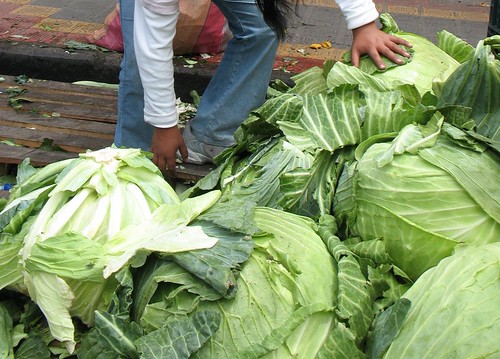
giant cabbages
Giant cabbages (Brassica oleracea) at a market in Uzbekistan. Photo by Lena Struwe (Creative Commons).
There are many, many species and cultivars of Brassica (or brassicas, as they are sometimes called in English). The cultivated brassicas are ancient and a result of a lot of breeding, selection, and crossing of genotypes, so their taxonomy is a bit messy within Brassica itself. Sorting out the current common names, their scientific names, and classification of the brassicas has to wait for another blog post (which is in the works). But, the summary is:

The Brassica genus is a member of the family Brassicaceae. Many other edible mustard plants are placed in other genera of the Brassicaceae. 

Wednesday, October 29, 2014

Red berry, blue berry... cranberry, lingonberry?

In Scandinavia many forest berries are wild-harvested and then used for home canning of jams and sauces, and also sold commercially to companies to flavor drinks, juices, yogurt, desserts, jams, and so on.  Many of these are members of the Vaccinium genus in the blueberry family (Ericaceae).

lingonberry, also called cowberry, Vaccinium vitis-idaea
Public domain photo from Lindman's Bilder ur Nordens Flora
One of the most common ones is lingonberry (Vaccinium vitis-idaea), a low-growing blueberry relative with small, red, shiny, and clustered berries on short upright stalks and with leathery oblong leaves.  They look like little tiny bushes sticking out of the soil among mosses and lichens in the taiga forests. Lingonberries are a very Swedish thing, and served with classic pancakes, blood pudding (maybe not so common anymore, but served in public school when I grew up in Sweden), and traditional cheese cake. It is an incredibly well-known and common wild-foraged plant in Scandinavia.

Common names are not regulated, they are just used by people as they see fit over the world.  This species is called lingonberry in English most of Europe and North America, cowberry in parts of North America, and lowbush cranberry in Alaska.  Other names are wortleberry and mountain cranberry. Which leads to giant confusion with the cranberry species below when you only use common names.  
(European) cranberry, Vaccinium oxycoccus
Public domain photo from Lindman's Bilder ur Nordens Flora

Other Vaccinium species also has red delicious berries, and among the most well known in the Northern hemisphere are the cranberries. In Europe it is mostly the cranberry species  Vaccinium oxycoccus, and in North American cranberry the larger-fruited Vaccinium macrocarpon. Cranberries grow mostly on the surface of the peat moss in bogs. They have lonely berries on long thin stalks that are laying on the ground, and long creeping branches with small leaves.  They are not grown commercially in Scandinavia, but are cultivated in other parts of the world.  Their tart flavor means that they are often used for jelly to be served with meat, and also for cranberry juice.

Cranberries and lingonberries are very different-looking plants when you see them side by side, but despite their large morphological differences there are common mistake.   As usual the stock photo market is among the worst, and here are an abundance of cranberry photos that actually show lingonberry (the opposite is much less common, so people seem to know how lingonberry looks like, but not how cranberries do). However, if the photos are from Alaska, they might be correct if they meant the low-bush cranberry(=lingonberry/cowberry), but there is no way of knowing if they use the Alaskan meaning of cranberry, or if they made a plant identification mistake (that is why we have scientific names to keep things in order) . Here are some examples of 'cranberry' photos featuring lingonberry (Vaccinium vitis-idaea):
Herbal Extracts Plus website, showing lingonberry images on the cranberry page.
Screenshot by BotanicalAccuracy.com.

Dreamstime stock photo website, showing a cranberry image for sale, that actually shows lingonberry.
Screenshot by BotanicalAccuracy.com.
Botanic Innovations LLC website, showing a lingonberry photo on the page for Cranberry seed oil.
Screenshot by BotanicalAccuracy.com.

Seeds-Gallery website, showing a lingonberry photo on the page for American Cranberry seeds.
In this case we know what species they mean since they give the scientific name
Vaccinium macrocarpon, and that is Vaccinium vitis-idaea on the photo.
Screenshot by BotanicalAccuracy.com.

Stockphoto for sale on CanStock website, showing a lingonberry photo
marked as 'tranbär' (cranberry).
Screenshot by BotanicalAccuracy.com.
The problem is that many companies buy stock photos to illustrate websites and newsletters and commercial packaging, and that there is no taxonomic quality control nor scientific species names on the labeling of stock photos. Many companies appears to be unaware of that they are using the wrong species in their materials until someone points it out, and by then they have inadvertently provided false marketing and information by using inaccurately named images.  Here is a packaging example of cranberry herbal tea, showing lingonberries and cranberries on the box:
Caribbean Dreams Cranberry Herbal tea, showing branches of lingonberries, not cranberries, but with a cranberry bog in the background, and cranberries along the edge.
To further confuse the American public, there is also 'cranberry bush' or tree, which is a species in the unrelated genus Viburnum and have nothing do to with Vaccinium's.  But that will be a different story.

So, to summarize how to tell these species apart in a photo:

Lingonberry, cowberry, lowbush cranberry (Vaccinium vitis-idaea): short plant with upright stems in forest, leaves leathery and oblong, often slightly curled at edges, berries clustered together

Cranberry (several species of Vaccinium, such as V. macrocarpon and V. oxycoccus): creeping plant on bogs, with long thin branches, leaves smaller, berries along on long thin fruit stalks

Wednesday, June 25, 2014

The species names of citrus - a sweet, sour, and sticky mess

Everybody knows the great and tasty citrus fruits - lemon, lime, orange, grapefruit, tangerine, and clementine, and maybe even the more rare bergamot, pomelo, tangelo, kumquat, yuzu, and tangelo.

Various slices of citrus fruits.  (Image from USDA, public domain.)
Since ancient times these plants have been cultivated, domesticated, and used by humans, and hybridization (on purpose or accidental) have created new hybrids. Citrus plants really do like to hybridize and since many of these hybridization and domestication events happened in the past it has been really hard to figure out these questions:
1) What is a species? (biological boundaries and evolution)
2) What is a hybrid? (= cross between two species, biology, evolution, and genetics)
3) What are the parent species of a hybrid? (genetics)
4) What is the correct scientific name for a species or a hybrid? (scientific nomenclature)

With the help of Dr. David Mabberley, an expert on the genus Citrus, I tried to sort this out since so many scientific names for citrus used on beauty and body products are inconsistent and sometimes flat out wrong and need to be updated. Please note that this is a work in progress for science, and that more research is needed to clarify relationships further.  Citrus relationships are a very messy business, indeed. So, here is the most up-to-date information, as far as I can discern.

This is a summary picture of the current hypotheses of the relationships of the most common species and hybrids of Citrus:

Origins and scientific names for the most commonly cultivated citrus fruits. 
Based on data from D.J. Mabberley's publications.

In botanical taxonomy a species (*) can only have one current and unique scientific name.  Other names are synonyms and their use should be phased out, and only be listed as synonyms in publications. This is to ease the communication and understanding in botany, horticulture, ethnobotany, and agriculture. We should all know what we talk about and we should talk about the same thing when we use a species name, right?
(* except for some fungi, but the mycologists are sorting that out now too, slowly. )

Hybrids either get their parents' names with an 'x' in between parent names (mother listed first), or a brand new species epithet preceded by a 'x'.  So, in the figure above, the name for orange can be listed as Citrus maxima x Citrus reticulata, or Citrus x aurantium.  You often see the name Citrus sinensis or Citrus x sinensis for oranges, but those are synonym names that should not be used anymore.

The group Citrus x aurantium includes a large array of different cultivars and varieties, such as orange, tangor, grapefruit, bitter orange, clementine and tangelo.  This is because the initial hybrids where then back-crossed to different parents, so Citrus x aurantium is really a large hybrid complex. 

So, what are then the most up to date names for cultivated and commercial citrus fruits? Here they are:


Common name
Current scientific name
Common inaccurate botanical and ingredient names
bergamot
Citrus × limon
Citrus aurantium var. bergamia, Citrus bergamia
bitter orange
Citrus × aurantium
Citrus amara, Citrus aurantium ssp. amara, Citrus iyo
cedrat
Citrus reticulata
Citrus x reticulata
citron
Citrus medica
Citrus medica var. acida
clementine
Citrus × aurantium
Citrus clementina
grapefruit
Citrus × aurantium
Citrus paradisi, Citrus × paradisi
kaffir lime (now called makrut lime)
Citrus hystrix

kumquat
Citrus japonica

lemon
Citrus × limon
Citrus limon, Citrus medica var. limon
lime
Citrus × aurantiifolia
Citrus aurantifolia
makrut lime
Citrus hystrix

mandarin
Citrus reticulata
Citrus x reticulata
orange
Citrus × aurantium
Citrus aurantium, Citrus aurantium var. sinensis, Citrus sinensis, Citrus × sinensis
pomelo
Citrus maxima
Citrus grandis
satsuma
Citrus reticulata
Citrus unshiu
Tahiti lime (seedless)
Citrus x latifolia

tangelo
Citrus × aurantium
Citrus tangelo
tangerine
Citrus reticulata
Citrus x reticulata,  Citrus × tangerina
tangor
Citrus × aurantium
Citrus nobilis, Citrus x nobilis
yuzu
Citrus × junos
Citrus junos

Many of the commercial, non-commercial, government or non-profit databases and publications do not use these updated names.  They are often lagging behind and changing names take time.

Want to read more about the delicious history and taxonomy of citrus plants?  Try these scientific papers if you want something more substantial than Wikipedia
    Mabberley, D. J. 1997. A classification for edible Citrus (Rutaceae). Telopea 7: 167-172.
    Mabberley, D. J. 2004. Citrus(Rutaceae): A review of recent advances in etymology, systematics, and medical applications. Blumea 49: 481-498 
     Zhang, D. & D. J. Mabberley.  Citrus in Flora of China. [Lots of interesting information here!]
    Li, X., R. Xie, Z. Lu, & Z. Zhou. 2010. The origin of cultivated Citrus as inferred from internal transcribed spacer and chloroplast DNA sequence and Amplified Fragment Length Polymorphism fingerprints. Journal of the American Society for Horticultural Science 135: 341-350. [Note - some of their results do not agree with the parent hypotheses presented above.]
    (Many thanks to Dr. David J. Mabberley for expert help and information for this post.)

    Monday, January 20, 2014

    Beware of the wronged coconuts

    Coconut palms are the quintessential symbol of tropical paradise. Spindly, tall trees with large feathery leaves wisp in tropical breezes on tropical beaches of white sand, under blue sky and by turquoise water.

    beach
    Beach in Hawaii with coconut palm tree.
    (cc) anda (: on Flickr.

    Up in the crown of the palm, a few coconuts are usually hanging, ready to fall down on you at any moment.  If they do, and they don't hit you, with some work you can get to the delicious inside of the coconut. (As a side note, when you consume the white parts inside, you eat or drink palm endosperm. In case you didn't know. )

    This staple food plant is spread all over the tropics, and a well-known plant in many cultures, even urban cities of today far from tropical beaches.  It is a plant that is easy to identify, delicious, and quite symbolic for us.  Therefore, it is quite strange that in popular culture so many illustrators get this plant wrong.  Really wrong. OK, as an illustrator you can simplify a lot, that is fine, but that is not the same as changing the properties of a plant and create something that doesn't exist.

    First, this is how a coconut plant looks like:

    Coconut palm, Cocos nucifera (Arecaceae)
    From Köhler's Medicinal-Pflanzen, public domain (Wikipedia)
    • Note the tall, skinny stem of even thickness, with horizontal leaf scars on it.
    • Note the big fruits (coconuts), aggregated close to the trunk at the top.
    • Note the leaves, in a rosette at the top
    • Note that each leaf is divided into tiny, tiny leaflets that are arranged like a feather along a midrib.  It it the midrib, the vein along the center, that holds together the leaf. Each leaf can be very long, up to 5 meters (15 feet) at least and all the little leaflets are loose from each other except at the midrib of the leaf.

    Here is a closeup of a coconut leaf, showing many leaflets along a midrib:

    Coconut leaves
    Coconut leaf showing many leaflets connected along the midrib.
    (cc) Azeem Azeez on Flickr.
    So, how do some of  the clipart masters and popular illustrators show coconut palms?  

    A quick Google search results in a variety of morphologies, most of them correct:
    Screenshot of Google image search 'coconut palm clipart free',
    (cc) BotanicalAccuracy.com
     but a few hits that look like this:

    "Palm Tree Clipart Image: Tropical Coconut Palm Tree Icon"
    Image courtesy of pamsclipart.com
    Coconut tree design
    (cc) SweetClipArt.com
    Screenshot from 123RF.com, a stockphoto website showing 'palm clip-art'.
    (c) 123RF.com, fair use.
    Screenshot of logos.co, showing clipart with 'double coconut palm tree island and sun'.
    (c) Hit Toon, fair use.

    Do you see the problems here?  Hint - stems and leaves.

    Coconut leaves are finely divided into small thin and long segments arranged along a midrib, like a feather.  But, these ones above have whole, undivided leaves, which sometimes are slightly lobed.  In fact, some of these leaves look more like banana leaves.

    The stems should be evenly thick, and they should have horizontal, evenly distributed leaf scars towards the top of the tree trunk.  These have a variety of stem patterns and shapes.

    One thing they get right, the placement of the coconuts.  But you wonder why are there nearly always three coconuts in a tree, don't you?

    So, shouldn't illustrators have the freedom to simplify, improvise, and design their own plants?  Sure.  But if you use one of these examples, then realize that the adults and kids that see these images will think that this is how a coconut palm looks like, when in reality, that is not true.  So, even if these images are fine and pretty as clip art and design pieces, they are still very botanically inaccurate.
    Screenshot of Google image search 'dog clipart free',
    (cc) BotanicalAccuracy.com
    Illustrators often simplify drawings of dogs, elephants and chickens too, but the characteristic features are always there, trunk, wagging tail, 4 legs, beak and feathers,. and so on.  To change the features that are characteristics for the coconut palm changes the species, it changes what you want to illustrate into an imaginary plant. It is like drawing a dog with a beak - we would complain that it no longer was a dog.  Many people don't realize that these palm drawings are incorrect, because we have lost a lot of botanical knowledge in our societies.  We all still know how a dog looks like though!

    Monday, January 13, 2014

    Celery - stems, stalks, or sticks?

    Celery is a vegetable and plant that is prominent in American cooking, and infuses both cooked and raw dishes with its very special flavor.  When I arrived in America I couldn't believe how much celery was added to tuna salads, soups, stews, and on plates with peanut butter.  Back in Sweden I don't think we ever had celery in our fridge, and I can't think of one Swedish traditional recipe that has celery in it.  So, it is a very common plant and food ingredient here in the US and many, many other cuisines, but it is not totally omnipresent.

    You would think people might like to  know what part of the plant they eat, right? Well, that becomes a problem for celery.  Many, many times there is big confusion about what those crunchy green celery sticks (also called 'ribs') are.

     First, here is the species in question, a celery plant.

    Celery plant (Apium graveolens, Apiaceae)
    Illustration (public domain) from Thomé (1885), Flora von Deutschland, Österreich und der Schweiz (link)
    And here, celery from a store.
    Celery ribs from a supermarket.
    (cc) Daniel James on Flickr (link)

    And here, the celery 'stick', the part that we eat, cut up into small, crunchy pieces. 

    Cut up celery sticks.
    (cc) Dey on Flickr (link)
    So, what part of the plant is this celery 'stick' really?  What are our options?  Well, plants have leaves, flowers, fruits, stems (branches, shoots, stalks), petiole (leaf stalk), pedicel (flower stalk), roots, tubers, and so on.  These are the botanical names we use for plant parts. All of these can be green, but mostly leaves, stalks, and stems are green.

    On the internet you can find answers to everything. So, lets begin:

    Yahoo Answers
    "Both the stem and the leaves of a celery plant are eaten, but the long crunch part many people put peanut butter on is the stem" [this was voted the best answer on "Is celery a stem or leaves?"] 

    Teacher's guide from New York Agriculture in the Classroom.com:
    "Celery we eat is the stem of the plant."

    Wikipedia:
    "Celery is used around the world as a vegetable for the crisp petiole (leaf stalk)."

    Wiki.answers.com:
    "Is a celery stalk a stem?"
    Answer: "yes so is rubarb"

    Ask.com:
    "Is celery a stem?"
    Answer: "No celery is a vegetable. Celery has a stem. A single celery plant has lots of stems actually. Most plants and trees have stems which are sometimes referred to as stalks."

    Are you confused yet?  Here are some more variations:

    GoodFood on BBC:
    "A collection of long, thick, juicy stalks around a central, tender heart"

    The Cook's Thesaurus lists celery as a 'Stalk Vegetable'. 

    Seattle Times, Food & Wine section:
    "By most definitions, a whole head of celery is a stalk and a single "stick" from the stalk is a rib. Some dictionaries use the accurate but clunky term "leafstalk" for a single rib."

    Well, the confusion is total.  The 'celery rib' that we cut off the plant and chop up or put peanut butter on is, based on internet facts, a stem, stalk, leafstalk, and petiole, all at the same time.  This is not possible. It is one thing and one thing only.

    Look at the plant.  At the top of your rib or stick are some leaves (unless you have cut them off, they were there before).  Only leaves.  There are no flowers, no growing part (with buds) that can lead to a stem that grows taller and taller, no fruits, no roots.  At the bottom of the rib is a white area and then a broadened base. You can easily break of a rib from the rest of the plant in your hand. 
    Celery, as you buy it in the stores.
    (cc) Popolon on Wikimedia (link)
    Leaves are attached to stems and branches.  Where is the stem on the celery?  It is that small, disk-shaped woody part in the center of the plant.  The roots have been cut off, so you no longer see them.  But how does celery grow bigger and taller?  When the plant is old enough it will shoot up one stem in the center of the leaves, and that stem will then grow taller than the leaves around it, have smaller leaves on it, and eventually flower and set seed high above the leaves at the base. Look at the first picture on this blogpost to see a flowering celery.

    The parts of a plant. Note stem, leaf, and petiole.
    (c) Pearson Biocoach (link)

    So, celery sticks and ribs are not stems.  They are part of the leaf, in fact, they are the leaf stalk, which is also called petiole. There are other ways to determine this too.  If you cut the celery rib across you can see many veins in it, and they are arranged as a U.  In most flowering plant stems, the veins are arranged in a circle, unless if it is a monocot, then the veins are arranged in a random scattered pattern.

    So, when you eat celery you eat the bottom part of the leaf, a fleshy petiole. Even if it doesn't look like a leaf, it is part of the leaf.

    One of the big problems here is that the word 'stalk' can be used for so many parts of a plant, including stem, leaf stalk, flower stalk, etc. No wonder people get confused.  In rhubarb you also eat the petioles (contrary to the answer on Wiki.Answers.com above). So who got it right in the quotes above?  Well, strictly speaking, only Wikipedia provided a completely correct answer.

    What is maybe most dismaying is that there are many biology lesson plans out there where teachers are told to cut celery ribs and put them in water with food coloring to show how water moves through stems (example). (Some lesson plans get it right too, of course).  Sorry teachers, you are showing how water and nutrients are moving in a leaf, not in a stem.  And that makes a difference both to the plant and to scientific understanding among children and college students.