Showing posts with label flowers. Show all posts

Tuesday, October 31, 2017

Missing the mark in state symbols (part 1): When a state flower isn't a flower

Countries, states, and provinces around the world often select symbolic things to represent their place and these are often considered typical for that region.  The US has the bald eagle as their symbolic country bird, and New Jersey (in US) has the oak as their state tree.  Each province ('landskap') in Sweden has a province plant, for example the white waterlily is the 'landskapsblomma' (province flower) of the Södermanland.  The same Swedish province also has a selected a moss (hart's-tongue thyme-moss), an animal (osprey), a fish (bream), a mushroom (black trumpet mushroom), an insect (the striped shield bug), and a rock ( special type of gneiss).

Many states in the United States have also selected foods, vegetables, animals, arts, fossils, insects, festivals, holidays as their special state symbols (see list here).  Sometimes this misses the mark, when selected species or objects do not really fit into their category based on biological or other definitions.  In this blogpost series I will present a few of these cases.

Botanical illustration of white pine from Bauer's book A Description of the Genus Pinus
made by A. B. Lambert. (PD-public domain, Wikimedia, NYBG.)
State Flower of Maine:
Unfortunately for Maine, the selected state flower in 1895, the white pine (Pinus strobus), do not have flowers.  It doesn't belong to the flowering plants, instead it is a conifer.  Conifers don't have carpels and they don't produce fruits, and they don't have sepals, petals, ovaries, or stamens.  Instead the ovules are places on bracts in short whorls (this is the female strobilus, which will become a pine cone), and the male parts that shed immense amounts of pollen in the spring, are on separate male strobili that look like little dusters (sometimes called tassels).  Other types of conifers are cedars, redwoods, and ginkgos. Luckily for Maine, the white pine is also the state tree since 1945, and that is botanically correct.

Conclusion: The state flower of Maine isn't a flower.

The eastern white pine is still a gorgeous tree.

Iced pine needles on Pinus strobus, eastern white pine. 
21 Dec 2008. Photo by Lena Struwe (creative commons, on Flickr)

Thursday, March 27, 2014

Flowering ferns and other mythical greens

The Philadelphia Flower Show is a paradise for winter-weary gardeners.  It can also be great fodder for botanical accuracy blog posts, but I have to say that this year's show was a lot better than usual. It was a delight to be there in this seemingly perpetual winter.  As for botanical inaccuracies, there was only one that stared you in the face, label and all.
"Flowering Ferns", label seen at Philadelphia Flower Show.
Photo © BotanicalAccuracy.com.
This label is from a Dutch company's booth where they were briskly selling "Flowering ferns".  How can that be? Isn't that like unicorns or flying horses? A combination of features that has never evolved, in horses, or in ferns.

So what is wrong with flowering ferns, apart from the fact that they don't exist?  On the tree of life of plants, ferns (and horsetails) are located above the mosses and liverworts at the base, and below the conifers (spruces, pines, etc.) and flowering plants.  Conifers and flowering plans have seeds, but ferns, lycopods, and mosses have spores spread from sporangia, never seeds. Flowers and fruits only occur in angiosperms (flowering plants), a group that evolved a lot later than ferns. So what is in this bag for sale in this booth? A fern or a flowering plant?

"Flowering Ferns" packet, seen at Philadelphia Flower Show.
Photo © BotanicalAccuracy.com.
It turns out to be a flowering plant with fern-like leaves. The species is Incarvillea delavayi. It is a member of the family of Bignoniaceae (bignons), together with trumpet creeper (Campsis), jacaranda (Jacaranda), and African tulip tree (Spathodea).  Common names for this species are hardy gloxinia, incarvillea, garden gloxinia, and Delavays trumpet flower.  To add the inaccurate name 'flowering ferns', just add confusion. 

Monday, January 6, 2014

The wrong mutants are singing the blues

An article published online today (Jan 6, 2014) in The New York Times ('Mutant Petunias Sing the Blues') about some exciting new research on the evolution of blue color of some garden petunias is illustrated with this nice photo:
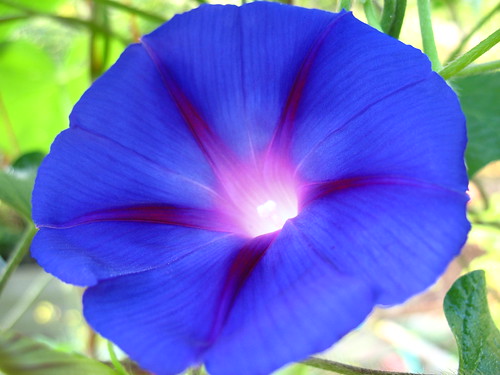
This is not a blue petunia, it is a morning glory.
Screen shot from NY Times website, Jan 6, 2014, by BotanicalAccuracy.com

Now, the only problem is that this is not a petunia. Petunias are members of the genus Petunia (simple!) in the Solanaceae, the potato family. This is unfortunately a photo of a morning glory, in the genus Ipomoea in the family Convolvulaceae, related to sweet potatoes. There are several kinds of morning glories, all in the same family, and both morning glories and petunias come in a wide array of flower color patterns.

The very interesting research  article has the right plant in its illustrations.
Illustration showing the mutation that causes blue petunias.
Image (c) Faraco et al. (2014) [Cell reports 10.1016/j.celrep.2013.12.009]
How could this happen in a  news article? Well, I guess someone at The New York Times did a stock photo search for petunia and found a nice photo, used it, and didn't realized it was mislabeled. Stock photo archives are full of mislabeled plants. So you pay for a photo, and then it turns out to show the wrong plant - not really what you paid for. Here is the source at iStock by Getty images:

The source of the wrong petunia image.
Screen shot from iStock by Getty Images website, Jan 6, 2014, by BotanicalAccuracy.com
Now, how do you tell a petunia from a morning glory? There are a couple of differences. Morning glories usually have heart-shaped leaves (like the ones on the photo above). Petunias have smaller, hairy oval-shaped leaves. Morning glories are climbers that twist their stem around something to climb higher and higher. Petunias grow like little bushy herbs, no climbing and twisting in them. The colorful petals are fused in both species into a giant flaring trumpet (the corolla) and can look similar, but the edge of the corolla is mostly even in morning glories, but uneven and notched in petunias.

Here is a petunia:
Petunia flower.
Public domain photo by Zirguezi.
Here is a morning glory:

Morning glories (Ipomoea sp., Convolvulaceae)
Blue morning glory flower.
(cc) Vilseskogen on Flickr.
[Thanks to BA for notifying me about this mistake. The New York Times have been notified.]

UPDATE 1: It seems that the wrong photo was first used by the renowned science magazine Science [!!!] in their highlight of this research.  See their article titled "ScienceShot: Broken Pump turns petunias blue", dated Jan 2, 2014. So The New York Times probably just reused the photo provide by Science. Here is the screenshot:

The first use of the wrong petunia image, in Science.
Screenshot from Science Magazine, on Jan 5, 2014, by BotanicalAccuracy.com
UPDATE 2: International Science Times picked a new photo for their article about this research, and again, a morning glory is on the photo, not a petunia. Screenshot below:

Another morning glory presented as a petunia.
Screenshot from International Business Times website, Jan 7, 2014, by BotanicalAccuracy.com.
UPDATE 3: Science fixed the photo error within a few hours of being notified, and now display petunias with their article.  Excellent! Here is the new photo, provided by the authors of the research study, Francesca Quattrocchio and Ronald Koes. 

A new photo with abundant and correct petunias on the corrected Science web page.
Screenshot from Science magazine website, Jan 9, 2014, by BotanicalAccuracy.com
UPDATE 4: Some other media organizations and companies got it right from the beginning.  Kudos to International Business Times, NBC News, Discover Magazine, Headlines and Global News.

UPDATE 5: New York Times removed the photo for their article and provided a correction on Jan 10, 2014. Thank you!

Sunday, December 15, 2013

Christmas Tree of Life does not need a little correction

Christmas Tree of Life Greeting Card
(c) blaghag on Zazzle, fair use.
Here is a cute little Christmas Tree of Life Greeting card designed by 'blaghag' for sale on Zazzle (link) , depicting the evolutionary relationships between reindeer, elves, Santa, and the four plants fir tree, poinsettia, holly and mistletoe, all accurately depicted and with nice scientific names.  Santa and the elves got new fictitious scientific names, nice! The description of the card includes this justification why this is a great card to buy:
"From mistletoe to reindeer, we're all share a common ancestor! Great card to send to your scientific and freethinking friends for the holidays."
I love this card.  It is innovative, fun, and for any science and reason-minded person, a great card.

Phylogenetic trees are read from the root to the tips. In this card, the root (the common ancestor) is at the top, and the branches to the different organisms are branching downwards.  Santa is most closely related to Elves, and reindeers are related to Santa+Elves, since they are all animals, all three of these groups.

Fir trees are conifers, and conifers are part of gymnosperms that are the sister branch/group to flowering plants (such as poinsettia, holly, and mistletoes).  Poinsettia is in the family Euphorbiaceae with spurges and they are placed in a bog group of plants called rosids (near roses, walnuts, birches, and many other plants). Mistletoes are in the family Santalaceae with lots of other parasitic plants, which are placed on another branch, sister to a giant group of plants called asterids.  Holly, an asterid, is in the family Aquifoliaceae. Other asterids are carrots, sunflowers, viburnum, and artichokes, the coffee plant, milkweeds, mint and potatoes.

[This post was updated on January 12, 2014.  The phylogenetic tree shown on the postcard is correct; mistletoes are sisters to holly plants.  The blog text has been changed so it is accurate based on the latest scientific findings. We regret the error. ]

Thursday, December 5, 2013

Canola oil flowers - four or five petals? Ask Trader Joe...


Canola oil is made from the rape seed plant's (several Brassica species) oil rich seeds, a member of the mustard family, the Brassicaceae.  Members of this family can easily be identified by their very typical flowers.  They have 4 petals, often white, yellow, or pink, situated in a cross-wise fashion, which gave them the old family name Cruciferae.  Yes, that is the same word beginning as in crucifix, a cross.

Brassicaceae flowers also have 6 stamens, and a central pistil that will develop into a fruit when/if pollinated.  All mustard plants have the same types of flowers, be it broccoli, garlic mustard, cabbage, arugula, or kohlrabi.  But there is one place, where the rule doesn't hold up...

Canola Oil Spray at Trader Joe's.
(cc) BotanicalAccuracy.com

On the Trader Joe's Canola Oil Spray bottle, sold only at the Trader Joe's supermarket, they have nicely added some flowers from the canola oil plant to the label. Only the flowers look like this:

Close up of Canola Oil Spray cans at Trader Joe's.
(cc) BotanicalAccuracy.com


So, what do we have here?  One flower with four petals (good!), and one flower with five petals (oops!).  And inside each flower, there are three 'things'.   I assume these might be stamens or pistils, but neither makes sense based on the numbers or shapes. The flowers are also never arranged in this particular fashion, but that is a minor point.

So, who cares? Well, if you make a piece of art you certainly can and should have artistic freedom. But, if you illustrate a product, the illustration should provide some knowledge (or excitement) or identification value about the product. It should be the real thing and not introduce errors or misunderstandings into the public's knowledge of plants and the product source.

The number of petals on mustard flowers are strictly determined by that group's bauplan, just like the 4 legs of a dog is based on a strict bauplan among allmammals. You don't go around and see a 5-legged dogs, do you? (5-legged dogs do exist, but are mutants, and they are even rarer in art.)

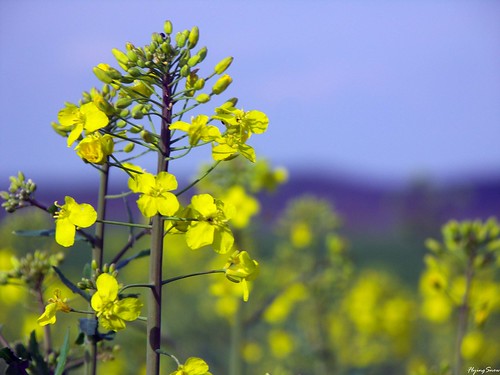
Here is the real canola:
canola
Flowering canola plant. 
(cc)  Melanie_B (Flying Snow) on Flickr.

So, in this case, the flowers on the label are used to illustrated the origin of a product, canola oil from the canola plant. There are no canola oil flowers with 5 petals. There are no canola oil flowers with 3 non-descript things in the center of the flowers.  If this drawing had been made with 4 petals it would have been equally pretty, and also accurate. So you start to wonder where things went wrong, with the illustrator, with the description to the illustrator, or to the designer of the label?

Monday, May 13, 2013

The difference between stems, stalks, and petioles in rhubarb

This is the wonderful rhubarb season!  And for those of us that like the tart flavor, the red shiny stalks (or sometimes green) makes us imagine pies, fruit tarts, jams, and sauces...   Rhubarb is also showing up in spring issues of cooking magazines, radio shows, newspaper articles, and so on.

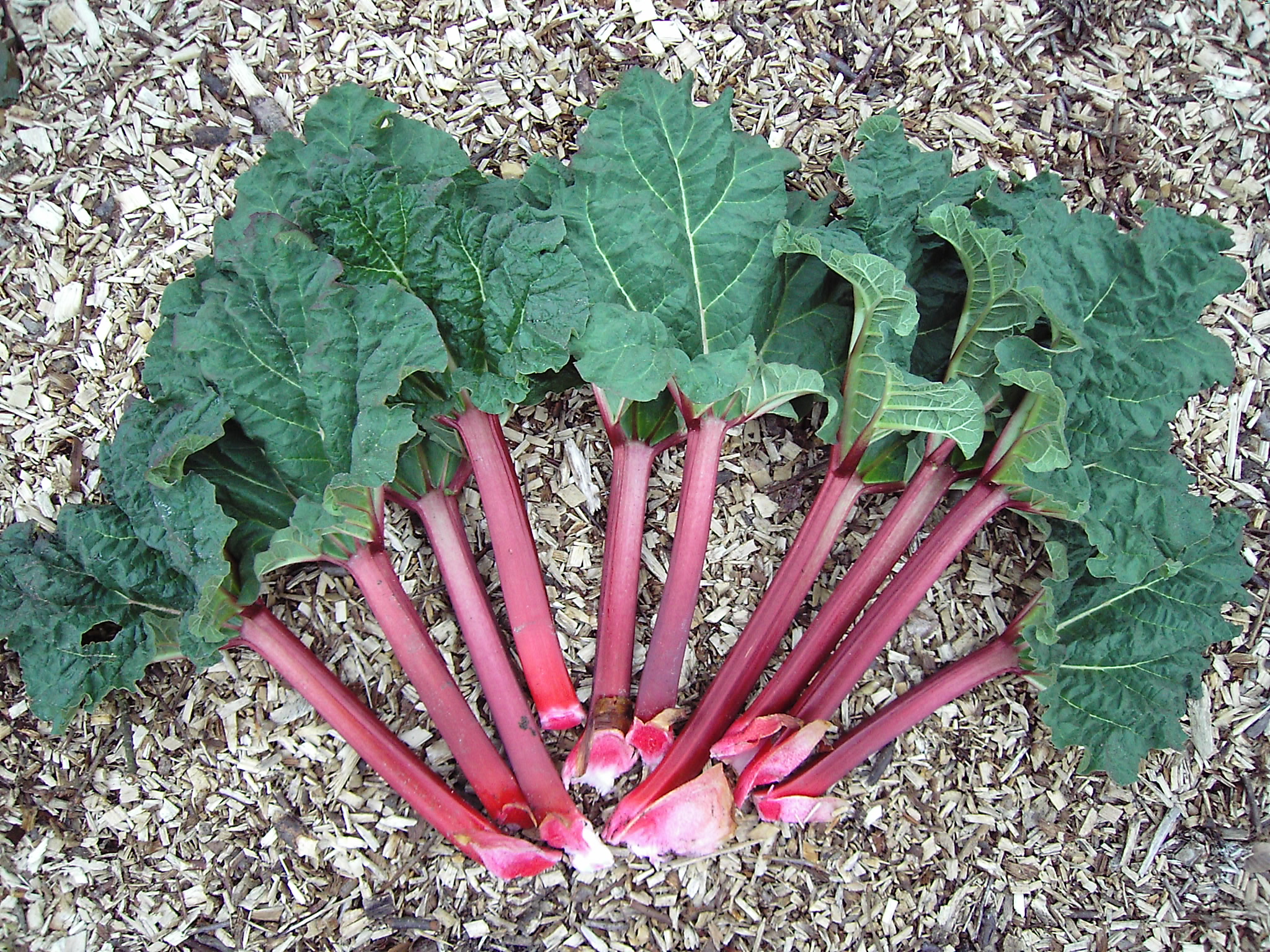
The inaccuracy that often is perpetuated with rhubarb is what we properly call the name the plant part we eat.  The 'stalks' we eat is the edible part of the otherwise toxic plant, and it is the leaf stalks.  The botanical, scientific name for this in English is 'petiole'.  This photo shows clearly how each stalk is connected to each leaf.
Rhubarb leaves with edible leaf stalks/petioles.
(cc) Dieter Weber, Wikipedia
The problem is that many times people inaccurately call it rhubarb stems.  A stem is a part of the plant that is a central shoot that holds the leaves, branches, flowers, and so on.  The true rhubarb stem is a hollow, nearly bamboo-like cylinder, which leads up to a terminal shoot that eventually develops flower buds. A stalk, on the other hand, can be both leaf stalk and the stem of a plant. Here is a photo of a rhubarb stem with flowers and small leaves:
Rhubarb flower, 12th May 2006
Flowering rhubarb stem.
(cc) Septuagent on Flickr
Here are some examples of botanical inaccuracy when it comes to written online rhubarb information :

Wikipedia: "The use of rhubarb stems as food is a relatively recent innovation, first recorded in 17th century." 
{But Wikipedia gets it right in the beginning of the article on rhubarb.}

Royal Horticultural Society (RHS): "Rhubarb is a rhizomatous perennial whose stems (‘sticks’) grown as vegetable but used mainly as a dessert."   "Stems should be pulled rather than cut to prevent rotting of the remaining stump. "

Mark Bittman for The New York Times: "Buy the smallest stems you can find and use a vegetable peeler or paring knife to remove the stringy outer layer."