Showing posts with label china. Show all posts

Wednesday, December 3, 2014

Why does the medicinal plant Astragalus membranaceus need to change its name? (updated)

(Please see nomenclature update at the end of this post)

One of the commonly used herbal medicines in Traditional Chinese Medicine (TCM) and other herbal pharmacopeias is the Chinese milk vetch, also called Radix Astragali, huang qi in Mandarin, or 黄芪 or 黄耆 in Chinese characters). Be aware though, that the name 'milk vetch' is used for many different species around the world, and some of them toxic. In the United States, the root of huang qi is widely sold as a dietary supplement ingredient, with the name astragalus established as the “standard common name” according to the rules by the US Food and Drug Administration, and therefore required on labels of such products sold in the USA. 
Huang qi is a species that has long been known scientifically as Astragalus membranaceus, a species that was described by Alexander von Bunge in 1868. Von Bunge was a German botanist that took part in several expeditions to Siberia, Mongolia, the Altai Mountains, and Central Asia's steppes in the mid-1800s.
Photo of astragalus / huang qi roots.
©  Steven Foster (link)
Unfortunately for von Bunge and for us today, it turns out that Bunge was not first with the name Astragalus membranaceus. Over 220 years ago, in 1794, Conrad Moench wrote a book on plants cultivated in the botanical garden of Marburg, Germany. In his book Moench renamed an Egyptian milk vetch species that Carl Linnaeus had earlier described as Astragalus trimestris, to Astragalus membranaceus.

All naming of plants have to follow the laws of scientific botanical nomenclature, which are called the International Code of Nomenclature for Algae, Fungi, and Plants, often shortened to ICN or 'The Code'. According to the rules of the Code you can't rename already described species on a whim, like Moench did. So Moench's name Astragalus membranaceus was properly described, but superfluous, i.e., it is an extra name that should not be used.
Photo of astragalus / huang qi.
©  Steven Foster (link)
Another rule in the Code is that when you describe a new species, you can't use a genus and species name combination that has already been used for another species. If you do, you create something called a homonym, a name that in reality applies to two different species. When you have two homonyms, the oldest name that was validly published according to all rules of the Code has priority (it wins!) and the younger name has to be put in disuse and replaced with another species name for the younger species. The younger homonym name then becomes an illegitimate name, which should not be used.

But since Moench's name was validly described, the name for the species von Bunge discovered in Asia could not be the same as Moench's species name (Astragalus membranaceus). It is too bad this situation was not realized until relatively recently. By now, there has been 160 years of published books and reports using von Bunge's species name, Astragalus membranaceus, for the Asian medicinal milk vetch. But, the nomenclature rules have to be followed or the naming of millions of species on Earth would turn into a chaotic mess. There is a possibility to get exceptions from the rules, but such exceptions have to be formally proposed and then voted on by a large botanical community of scientists that only meet at the International Botanical Congress every 4 years.
The five taxonomic groups relevant for 'huang qi' nomenclature.
Geographic information is approximate.
© BotanicalAccuracy.com.

So, von Bunge's species from Asia, the medicinal Chinese milk vetch, needed a new name. Botanists went through the literature to see if other earlier botanists had maybe described other new species based on plants that were now considered to be part of Bunge's species. And yes indeed, there were several names available for plants that sometimes had been considered separate from Astragalus membranaceus, but now were included, so the oldest of those species names can be used.

The problem was that the botanists could not agree on how to divide up the plants into different species. In taxonomy we often talk about 'lumpers' (botanists that like to have a few, widespread and morphologically variable species) and 'splitters' (who like many small species, often from small geographical areas and more uniform characteristics).

The current world expert on this group of milk vetches is Dr. Xiangyun Zhu from Institute of Botany in Beijing in China, who has graciously helped us understand this complicated issue. After detailed morphological analyses, Dr. Zhu showed that the species Astragalus penduliflorus from Europe, is actually the same species as the medicinal plant known as Astragalus membranaceus in East Asia (see his paper in Nordic Journal of Botany 23: 283-294 (2005). When biologists learn more about species, sometimes their names change to reflect our new understanding of their relationships and properties. It might be inconvenient at times, but is part of scientific progress.

So, the current treatment is that several milk vetch species are being merged into one single species. Several names are available. Astragalus penduliflorus was described first, by the famous naturalist Lamarck in 1779. Therefore it is clear that Astragalus penduliflorus then is the oldest name and the one that now should be used for huang qi. Not all botanists might agree with this, but this is the best and most science-based naming so far.

The current species names and distribution of 'huang qi' and other varieties in its species (note all are included).
Geographic information is approximate.
© BotanicalAccuracy.com.
  Within a species you can also have subspecies, varieties, and forms. Botanists frequently discuss such fine-tuning of taxonomy and might have arguments over it. Sometimes the decisions can have economic and ethnobotanical implications. For example, if only one subspecies contains an active compound, then it is important that you use the right subspecies and not just any plant from the whole species.
In the case of the medicinal Chinese milk vetch, the species previously known as Astragalus membranaceus now has the new taxonomic name Astragalus penduliflorus ssp. mongholicus var. dahuricus.

This means that huang qi belongs to the subspecies mongholicus, and within that subspecies to the variety dahuricus. So only the species name "Astragalus penduliflorus" will not guarantee you to get the traditionally used huang qi. Make sure that the label (or content) is more specific than just the species name since this is such a geographically widespread and morphologically (and most likely chemically as well) variable species. 

Another name that has been used for the Asian Astragalus membranaceus is Astragalus propinquus.  It is the name that is currently listed in The Plant List from Kew Gardens, which is based on the LegumeWeb database.  Unfortunately, those have outdated information and need to be updated.  Especially for legumes (Fabaceae), be aware that The Plant List is not properly updated (yet).
Astragalus propinquus is now also a synonym of Astragalus penduliflorus ssp. mongholicus var. dahuricus.

Astragalus (huang qi) herbal supplement sold by GNC in the US.  Source: GNC (fair use).
In Chinese medicine, the criteria for appropriate medicinal plant material might be even more strict, such as that only one particular region would be the most wanted producer of a medicinal plant. Such generally accepted regions or places for high-quality material of each medicinal plant are called ‘Daodi’ in Chinese (see review article on this by Zhao et al., 2012, cited below). The plant materials produced in a 'Daodi' place is generally acknowledged to be the most bioactive and of the best quality. So the price of a ‘Daodi’ medicinal plant is usually higher than the same plant species produced in other areas. For huang qi, the ‘Daodi’ plants are the ones produced in the Shanxi Province of China. The materials from other non-‘Daodi’ provinces can be sold, but would not be as accepted or wanted by the customers.


Cultivation of astragalus / huang qi.
©  Steven Foster (link)
What I have described above is called botanical nomenclature, the naming of plants and the rules that guide their scientific names. These rules are active worldwide in botany and mycology and know no political borders. Slightly separate from nomenclature is the research on circumscribing a species. That means that you do research on which individuals belong to one species and not another, or if a species might be one, two, or three separate species. If you lump two species together and consider them one single species, then you also have to follow the rule of priority. The oldest species name in your lumped species will become the species name for the new, larger species, and the younger name will become a synonym, a name that shouldn't be used.

Conclusion:
The current scientific name for Astragalus membranaceus
(as described by Bunge and native to Asia) is:

Astragalus penduliflorus ssp. mongholicus var. dahuricus
or
Astragalus penduliflorus var. dahuricus
(two name options for the same variety)  

UPDATE:
A proposal has been submitted to conserve the name Astragalus membranaceus published by Bunge, which would make it available for this species again. The proposal will be voted on by the botanical community at the International Botanical Congress in China in Summer of 2017. 


The details: Jinshuang Ma, Cheng Du, Wendy L. Applequist and Peiliang Liu have proposed the conservation of the name Astragalus membranaceus Fisch. ex Bunge and the rejection of A. membranaceus Moench. The two names are the same but indicate different species and published by different authors, so they are homonyms, and only one name can be considered legitimate and that is the earliest published one. Conservation is an exception from rule of priority ('first publication rules') outlined in the Botanical Code, and it would make the name A. membranaceus Fisch. ex Bunge a legitimate name, despite being published after Moench's name (which was used for another species). A recent taxonomic revision treated this medicinal species as a variety of European A. penduliflorus Lam. (Zhu, 2005), specifically A. penduliflorus var. dahuricus X.Y.  Zhu. This large circumscription of A. penduliflorus is so far only accepted by few botanists. If the name A. membranaceus Fisch. ex Bunge is not conserved, and there is a desire to treat the Asian populations as a species apart from the European A. penduliflorus, the name A. mongholicus is available for this species. Because A. membranaceus is such a well-known name to the public and it is widely used in commercial activities and scientific research papers, the proposers for the conservation of the name thought it is better to keep A. membranaceus for this medicinal plant, i.e., make it officially available through a decision to conserve it (Du et al., 2016). Thus, if the plant known as 'Huangqi' in China is considered a different species than A. penduliflorus, the name A. membranaceus Fisch. ex Bunge could be used as an accepted name for this Asian taxon. However, the ratification of a conserved name has to be decided through a vote during the nomenclature meeting of XIX International Botanical Congress (IBC), so whether this species (as an Asian entity) will be called A. membranaceus or A. penduliflorus will be decided in Summer of 2017 in Shenzhen, China. IBC congresses only occur every five years, and they handle many proposals of these types.

Authorship: This blogpost was written by Lena Struwe and Shen-hao (Shawn) Yao.

Acknowledgements:
Many thanks to Xiangyun Zhu and Steven Foster, who both provided excellent taxonomic and ethnobotanical insights and photographs for this article.

References and more suggested reading:

Du, C., Applequist, W.L., Liu, P., & Ma, J. 2016. (2431) Proposal to conserve the name Astragalus membranaceus Fisch. ex Bunge against A. membranaceus Moench (Leguminosae). Taxon, 65(2) 392-393.

Foster, S.  1998. Astragalus: A Superior Herb. Herbs for Health, Sep/Oct 1998: 40-41.

Foster, S.
2004. The Secret Garden: Important Chinese Herbs in American Horticulture: A Photo Essay. HerbalGram. 2004; 64:44-51 (link)

Zhao,  Z., P. Guo, & E. Brand. 2012. The formation of daodi medicinal materials. Journal of Ethnopharmacology 140: 476-481.

Zhu, X-Y. 2005. Revision of the Astragalus penduliflorus complex (Leguminosae - Papilionoidae). Nord. J. Bot. 23: 283-294.

Tuesday, November 18, 2014

Fungi this and fungi that, fungi known and fungi what?

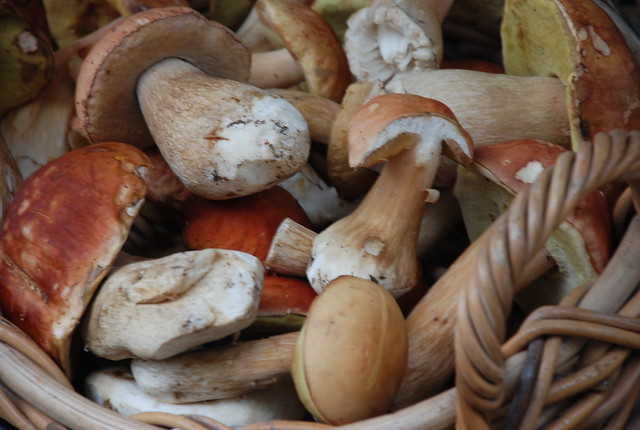
All food products have to be marked with their ingredients, but it becomes a little complicated when what is in the packet of dried mushrooms you have just bought turns out to be three unnamed porcini species. Bryn Dentinger and Laura Suz from the Jodrell Lab at Royal Botanic Gardens, Kew (in United Kingdom) describe how they figured this out using modern molecular evolutionary methods in a recent paper in the journal PeerJ. (Here is a link to their research paper.)

porcini mushrooms at the market
Porcini mushrooms for sale.
Photo by Kristen Taylor (Creative Commons license, link)

So, how could this happen, and how common is this? We have described a lot of species on Earth, especially among plants.  But there are some organismal groups that are large uncharted areas on our biodiversity maps where not much is known, and fungi, bacteria, and insects are among those groups.  If you are looking for a career focused on new species descriptions, I recommend those groups, and maybe also other invertebrate groups and smaller algae.  There is a lot to find out!

Dentinger and Suz explain fungal discoveries: 
"Although taxonomists regard new fungal taxa as commonplace, they are often of little apparent consequence to human society and largely go unnoticed by the public. Like all groups of organisms, our knowledge of fungal diversity is biased towards taxa of greatest concern to ourselves, such as edible fungi. For example, wild mushrooms collected and sold as food around the world generally belong to a handful of well-known taxa (e.g., truffles and chanterelles), most of which have long histories of use in European cuisine. However, even some of these well-known groups have been shown to contain underappreciated levels of diversity. "
How did the researchers figure out that the package of Chinese porcini a friend of theirs had bought in London and brought to them as a dinner item had new species in it? Porcini belong to the Boletus genus, which include some incredibly delicious species, as well as some you definitely should not eat. I assume they got curious about the brown fungal bits in the bag, and decided to check it out. They took their samples to their molecular phylogenetics lab, extracted the DNA from individual pieces, and then compared those DNA sequences with all known porcini mushrooms' DNA. It turned out that the DNA sequences were different enough to warrant the first description of three new species from China. These new porcini species were named after Chinese common words: Boletus bainiugan, Boletus meiweiniuganjun, and Boletus shiyong (link to description article here). 

Can the same thing happen when you buy a bag of dried food plants?  Yes, it could, but it is probably less likely because we know more about the plant species of the world. 

Reference: Dentinger and Suz (2014), What’s for dinner? Undescribed species of porcini in a commercial packet. PeerJ 2:e570; DOI 10.7717/peerj.570

PS. So, truth to be told, fungi are not actually plants, but fungi have historically been included in botany since they also are sessile organisms stuck in the ground on land (usually, but not always). In reality fungi are actually more close evolutionary speaking to animals than to plants.  So, mushrooms are more closely related to bacon, than to potatoes and bamboo shoots. Vegetarians might want to consider that. :)  


Thanks to our blog reader EC for sending me the link to this interesting paper. 

Friday, March 15, 2013

Royal Copenhagen: Flora Danica (example 2)

In this earlier post I explained the background of the Flora Danica series produced by Royal Copenhagen.  Here is another new design from 2012, listed as 'Stedmoderblomst' in the Danish catalog, and as 'Pansy' in the English version of the catalog.

 
 Source: Royal Copenhagen.
 
Stedmoderblomst is one of several species of violets (genus Viola, family Violaceae) that are common in Denmark, and the most common species of these are Viola arvensis and Viola tricolor.  None of the violets look the species depicted on this pattern, however.
Source: Royal Copenhagen.

This is how the violets look like:


Viola arvensis.
Source: Bernd Haynold via Wikimedia, Creative Commons.


Viola tricolor
Source: Incola via Wikimedia, Public Domain.


A detailed look at the plant depicted on this china shows that it is likely a monkshood (Aconitum, family Ranunculaceae). A search through the illustrations of Flora Danica provided by the Royal Library in Copenhagen yields this plate, Aconitum napellus, plate number 1698.

Aconitum napellus. Source: The Royal Library, Flora Danica.
So, from a dainty little violet, to one of the most toxic plants in Europe. 

The Aconitum illustration shows a stem with flowers and also a flower that is removed from the stem, and then pressed open and flattened.   Now, compare this illustration to the pattern painted onto the Royal Copenhagen plates and cups. 
 
 Source: Royal Copenhagen.

Not only is the species wrong, but the parts of the plant has been removed and then reassembled.  An opened, slightly destroyed flower has been reattached to a partial stem with flowers, The plant morphology has completely changed, and a new plant mutant has been created.  Of course this is perfectly fine in the creation of art, but not if you say that all the imagery is from historic Flora Danica and depict the plants of Denmark. 

Tuesday, March 12, 2013

Royal Copenhagen: Flora Danica (example 1)

One of the most expensive china sets in the world, Flora Danica, is produced by the renowned company Royal Copenhagen, and the designs are taken from the historic illustrated works of Flora Danica ('The Flora of Denmark').  For their recent designs, they incorrectly named not one, but two, of the species they have used from the flora illustrations.  Both species are commonly known plants, not rare species.
Source: Royal Copenhagen's 2012 brochure.
The two 2012 designs are also prominently featured in their marketing brochure. Both designs are made by Anja Vang Kragh, a freelance designer. This mistake really surprised me considering the long tradition of excellence in botany in Denmark, and that all illustrations from Flora Danica are available with scientific names.  
The two plates that have the wrong species listed.
Source: Royal Copenhagen's 2012 brochure.
Example 1: The lion's teeth that was a goat's beard

This pattern is listed as 'Dandelion' in the English 2012 catalog, and as 'Mælkebøtte' (the Danish name for dandelion) in the Danish version of the 2012 catalog. Dandelion (Taraxacum officinale) is one of the most common weeds in the northern hemisphere and most everybody can recognize a dandelion. This is how the newly designed china looks like:

'Dandelion' pattern from Royal Copenhagen's Flora Danica series. Image source: Royal Copenhagen.
A quick search through The Kongelig Bibliotek's online Flora Danica illustrations, shows that 'Mælkebøtte' brings you to Taraxacum, just as it should. However, none of the plates are the design used on the plates above.  Instead, the design on the china is most likely from this Flora Danica illustration (see below), with parts removed, the illustration inverted, parts moved and copied in, and so on.

Tragopogon minor, Flora Danica, plate 2838.
Source: http://www.plantgenera.org; Public Domain.
This Flora Danica illustration features Tragopogon minor, a species that now goes under the name Tragopogon pratensis subspecies minor. It is called 'Meadow's salsify' or 'Showy Goat's Beard' in North America (the edible salsify belongs to the genus Scorzonera, also in this family).  It is considered a weed in North America, and it was introduced from Eurasia. It is a very common plant in southern Scandinavia, and it is in the same family (Asteraceae) as dandelion.
      You can easiest tell these two genera apart based on the long narrow leaves, while dandelion has toothed leaves, like lion's teeth, which is how it got its common name in English.
      Interestingly enough, Royal Copenhagen has already used this exact illustration on a previous Flora Danica piece, see here. It was then used with the correct species name in their catalog.

Example 2 will focus on the 'pansy' or 'stedmoderblomst' design, also shown above in the photo from the 2012 brochure.