Showing posts with label plant morphology. Show all posts

Tuesday, November 29, 2016

Anatomy of artichoke heads

This educational and interactive image from the artichoke company Ocean Mist Farms in California on the Anatomy of an Artichoke made me scratch my head. It is stated on their website as the largest artichoke producer in the US, and has a long history growing fresh vegetables of many kinds. On their website they provide a nice interactive feature where you can slide a slider across and see the inside, the anatomy, of an artichoke:
Screenshot of Anatomy of an Artichoke on the Ocean Mist website.
Screenshot by Botanicalaccuracy.com, 29 Nov 2016 (fair use).

 Unfortunately, the botanical facts about the artichoke head are not anatomically correct.
 The text states:
"You may be interested to know that the Artichoke is actually the bud of a plant from the thistle family and at full maturity, the plant grows to a width of about six feet and a height of three to four. If not harvested from the plant, the bud will eventually blossom into a beautiful, blue-violet flower, which is not edible. The bud contains the Heart, the delightful, meaty core of the Artichoke, and is topped by a fuzzy center, or choke, which is surrounded by rows of petals, which protect the Artichoke Heart. With their tiny thorns, the Artichoke’s petals reveal their thistle heritage."
The artichoke is indeed a type of giant thistle, and if you let it flower it will open up to show a flower head similar to thistles, just much larger.  But note the word HEAD, which is used for flower arrangements (inflorescences) that have tightly packed and unstalked flowers.

The thistles are part of the sunflower family, the Asteraceae, which is also the home of dandelions, marigolds, tarragon, mugwort, chicory, lettuce, chrysanthemum, and dahlias.  All of the species in this family have tiny flowers collected in a cup- or saucer-like head (capitulum), that is surrounded on the lower side by bracts (modified small leaves).  The flowers are small and tightly packed, often with tubular narrow (disc) flowers in the center and sometimes with longer, flattened (ray) flowers along the edge, like in a sunflower. One group of species have only ray flowers, like in dandelions.  In thistles, there are only tubular disc flowers, and the bracts are long and initially covers the whole sides and top of the head.

So, in their effort to educate the public about the fascinating anatomy of the floral heads of artichokes, Ocean Mist Farms manages to really mix things up.  Here is the corrected version of their image:
Corrected version of the screenshot of Anatomy of an Artichoke, original from Ocean Mist Farms. Modified image by Botanicalaccuracy.com. (fair use, cc-by)

Their text should read something like this instead:
"You may be interested to know that the Artichoke is actually the YOUNG FLOWER HEAD of a plant from the thistle family and at full maturity, the plant grows to a width of about six feet and a height of three to four. If not harvested from the plant, the HEAD will eventually blossom into a FLOWER HEAD WITH beautiful, blue-violet flowerS, which ARE not edible. The HEAD contains the Heart, the delightful, meaty core of the Artichoke, and is topped by a fuzzy center OF YOUNG FLOWERS, or choke, which is surrounded by rows of BRACTS, which protect the Artichoke Heart. With their tiny SPINES, the Artichoke’s BRACTS reveal their thistle heritage."
It is not too late to learn and this is not an uncommon mistake in the food world. Hopefully they fix this information soon.  If you want to dig deeper into the anatomy of artichokes, I recommend this post on the Botanist in the Kitchen blog.
(Thanks to RO for sending me this example of botanical inaccuracies in commercial products and companies.)

Monday, January 13, 2014

Celery - stems, stalks, or sticks?

Celery is a vegetable and plant that is prominent in American cooking, and infuses both cooked and raw dishes with its very special flavor.  When I arrived in America I couldn't believe how much celery was added to tuna salads, soups, stews, and on plates with peanut butter.  Back in Sweden I don't think we ever had celery in our fridge, and I can't think of one Swedish traditional recipe that has celery in it.  So, it is a very common plant and food ingredient here in the US and many, many other cuisines, but it is not totally omnipresent.

You would think people might like to  know what part of the plant they eat, right? Well, that becomes a problem for celery.  Many, many times there is big confusion about what those crunchy green celery sticks (also called 'ribs') are.

 First, here is the species in question, a celery plant.

Celery plant (Apium graveolens, Apiaceae)
Illustration (public domain) from Thomé (1885), Flora von Deutschland, Österreich und der Schweiz (link)
And here, celery from a store.
Celery ribs from a supermarket.
(cc) Daniel James on Flickr (link)

And here, the celery 'stick', the part that we eat, cut up into small, crunchy pieces. 

Cut up celery sticks.
(cc) Dey on Flickr (link)
So, what part of the plant is this celery 'stick' really?  What are our options?  Well, plants have leaves, flowers, fruits, stems (branches, shoots, stalks), petiole (leaf stalk), pedicel (flower stalk), roots, tubers, and so on.  These are the botanical names we use for plant parts. All of these can be green, but mostly leaves, stalks, and stems are green.

On the internet you can find answers to everything. So, lets begin:

Yahoo Answers
"Both the stem and the leaves of a celery plant are eaten, but the long crunch part many people put peanut butter on is the stem" [this was voted the best answer on "Is celery a stem or leaves?"] 

Teacher's guide from New York Agriculture in the Classroom.com:
"Celery we eat is the stem of the plant."

Wikipedia:
"Celery is used around the world as a vegetable for the crisp petiole (leaf stalk)."

Wiki.answers.com:
"Is a celery stalk a stem?"
Answer: "yes so is rubarb"

Ask.com:
"Is celery a stem?"
Answer: "No celery is a vegetable. Celery has a stem. A single celery plant has lots of stems actually. Most plants and trees have stems which are sometimes referred to as stalks."

Are you confused yet?  Here are some more variations:

GoodFood on BBC:
"A collection of long, thick, juicy stalks around a central, tender heart"

The Cook's Thesaurus lists celery as a 'Stalk Vegetable'. 

Seattle Times, Food & Wine section:
"By most definitions, a whole head of celery is a stalk and a single "stick" from the stalk is a rib. Some dictionaries use the accurate but clunky term "leafstalk" for a single rib."

Well, the confusion is total.  The 'celery rib' that we cut off the plant and chop up or put peanut butter on is, based on internet facts, a stem, stalk, leafstalk, and petiole, all at the same time.  This is not possible. It is one thing and one thing only.

Look at the plant.  At the top of your rib or stick are some leaves (unless you have cut them off, they were there before).  Only leaves.  There are no flowers, no growing part (with buds) that can lead to a stem that grows taller and taller, no fruits, no roots.  At the bottom of the rib is a white area and then a broadened base. You can easily break of a rib from the rest of the plant in your hand. 
Celery, as you buy it in the stores.
(cc) Popolon on Wikimedia (link)
Leaves are attached to stems and branches.  Where is the stem on the celery?  It is that small, disk-shaped woody part in the center of the plant.  The roots have been cut off, so you no longer see them.  But how does celery grow bigger and taller?  When the plant is old enough it will shoot up one stem in the center of the leaves, and that stem will then grow taller than the leaves around it, have smaller leaves on it, and eventually flower and set seed high above the leaves at the base. Look at the first picture on this blogpost to see a flowering celery.

The parts of a plant. Note stem, leaf, and petiole.
(c) Pearson Biocoach (link)

So, celery sticks and ribs are not stems.  They are part of the leaf, in fact, they are the leaf stalk, which is also called petiole. There are other ways to determine this too.  If you cut the celery rib across you can see many veins in it, and they are arranged as a U.  In most flowering plant stems, the veins are arranged in a circle, unless if it is a monocot, then the veins are arranged in a random scattered pattern.

So, when you eat celery you eat the bottom part of the leaf, a fleshy petiole. Even if it doesn't look like a leaf, it is part of the leaf.

One of the big problems here is that the word 'stalk' can be used for so many parts of a plant, including stem, leaf stalk, flower stalk, etc. No wonder people get confused.  In rhubarb you also eat the petioles (contrary to the answer on Wiki.Answers.com above). So who got it right in the quotes above?  Well, strictly speaking, only Wikipedia provided a completely correct answer.

What is maybe most dismaying is that there are many biology lesson plans out there where teachers are told to cut celery ribs and put them in water with food coloring to show how water moves through stems (example). (Some lesson plans get it right too, of course).  Sorry teachers, you are showing how water and nutrients are moving in a leaf, not in a stem.  And that makes a difference both to the plant and to scientific understanding among children and college students.

Monday, May 13, 2013

The difference between stems, stalks, and petioles in rhubarb

This is the wonderful rhubarb season!  And for those of us that like the tart flavor, the red shiny stalks (or sometimes green) makes us imagine pies, fruit tarts, jams, and sauces...   Rhubarb is also showing up in spring issues of cooking magazines, radio shows, newspaper articles, and so on.

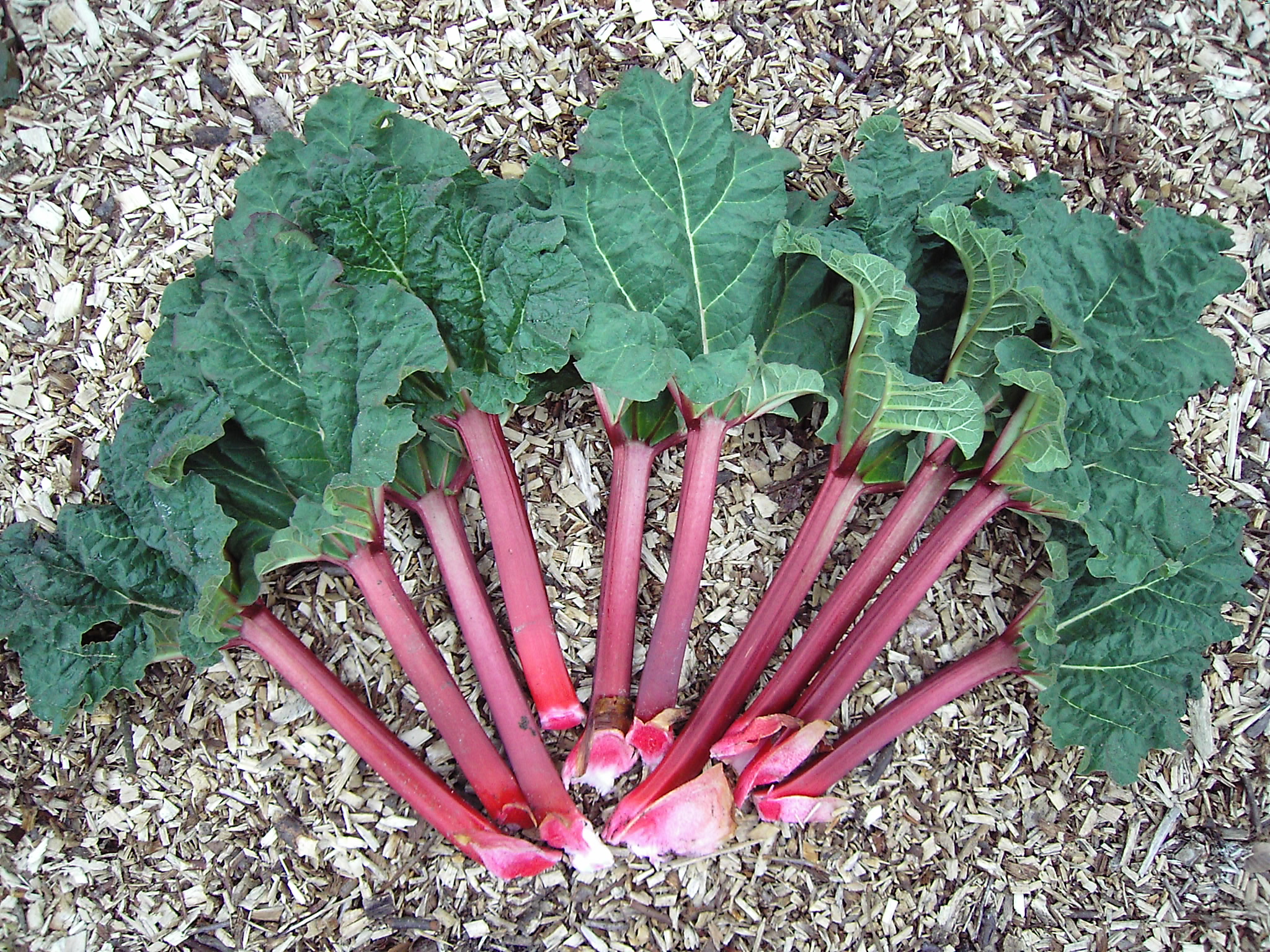
The inaccuracy that often is perpetuated with rhubarb is what we properly call the name the plant part we eat.  The 'stalks' we eat is the edible part of the otherwise toxic plant, and it is the leaf stalks.  The botanical, scientific name for this in English is 'petiole'.  This photo shows clearly how each stalk is connected to each leaf.
Rhubarb leaves with edible leaf stalks/petioles.
(cc) Dieter Weber, Wikipedia
The problem is that many times people inaccurately call it rhubarb stems.  A stem is a part of the plant that is a central shoot that holds the leaves, branches, flowers, and so on.  The true rhubarb stem is a hollow, nearly bamboo-like cylinder, which leads up to a terminal shoot that eventually develops flower buds. A stalk, on the other hand, can be both leaf stalk and the stem of a plant. Here is a photo of a rhubarb stem with flowers and small leaves:
Rhubarb flower, 12th May 2006
Flowering rhubarb stem.
(cc) Septuagent on Flickr
Here are some examples of botanical inaccuracy when it comes to written online rhubarb information :

Wikipedia: "The use of rhubarb stems as food is a relatively recent innovation, first recorded in 17th century." 
{But Wikipedia gets it right in the beginning of the article on rhubarb.}

Royal Horticultural Society (RHS): "Rhubarb is a rhizomatous perennial whose stems (‘sticks’) grown as vegetable but used mainly as a dessert."   "Stems should be pulled rather than cut to prevent rotting of the remaining stump. "

Mark Bittman for The New York Times: "Buy the smallest stems you can find and use a vegetable peeler or paring knife to remove the stringy outer layer."