Friday, January 10, 2014

Frosty fern? It is a variegated spike moss

Before Christmas a fern-looking plant often shows up in the supermarkets and is marketed as 'frosty fern',  a name it gets from its fern-like leaves (more on that later) and white-tipped branches.

'Frosty fern' for sale, with rather zoologically inaccurate cardinals as highlights, but that is for another blog.
Photo (cc) BotanicalAccuracy.com.

Frosty fern for sale at Shoprite in New Jersey, USA.
Photo (cc) BotanicalAccuracy.com

But, in fact, it is no fern at all.  It is a Selaginella, a spike moss in the lycopod group.  It is also called African club moss or Krauss' spike moss, and its scientific species name is Selaginella kraussiana (family Selaginellaceae).  Many club mosses belong to another lycopod family, the Lycopodiaceae.

Ferns below to a different branch on the green tree of life, they are not lycopods.  The two evolutionary branches are about as different as a turtle and a salamander. We easily keep salamanders (and other amphibians) apart from turtles and tortoises in our brains, but green things from many different branches on the tree of life look very similar to us.

Lycopods evolved before ferns and have spores, just like ferns, but lycopods differ a lot in how their leaves are constructed.  Look closely, and you can see that lycopods have branches and stems with tiny scale-like leaves.  These leaves are called lycophylls. 

Some people mix up this plant with mosses, but real mosses are smaller and do not have roots like lycopods do.  Mosses also have scale-like leaves, called microphylls, and they are very similar to lycophylls just smaller.  So club mosses and spike mosses are not mosses.
A branch of a Selaginella (Frosty Fern) showing many, many small scale-like leaves.
Photo (cc) BotanicalAccuracy.com
Ferns on the other hand have large leaves, often divided, and these leaves are called euphylls, which means 'true leaves'.  Other groups with true leaves are conifers (needles!) and all flowering plants (oaks, grasses, and dandelions and such).  True leaves have many veins in them (look closely), but lycophylls and microphylls have only one vein in each leaf.

So, the common name of this plant is often 'frosty fern', and it is not uncommon for common names to give the wrong impression of a plant's taxonomic belonging.  Just think of names such as 'lucky bamboo' (not a bamboo at all) and reindeer moss (a lichen).  Common names are everyday names, often traditional, used among people so we can communicate about the plants around us.  The real problem starts when we think this plant is a fern.  And that happens, and then the botanical mistake is a fact induced by the not-so-great common name.  Such as in this example:
"Never allow the soil to dry around your frosty fern. This fern doesn't tolerate dry periods or waterlogged soil."  (link to source at GardenGuides.com)
Suddenly the spike moss became a fern for real in that quote. And suddenly, a botanical inaccuracy have been introduced in our way of thinking about this plant, because of its name. So therefore it is best to avoid such common names and instead use names that are more appropriate, like Krauss' spike moss.  

The same thing can happen among animals, but usually we know that guinea pigs are not pigs, and that seahorses are not horses, and that ant lions are only very, very distantly related to lions. All because animals are a little more charismatic than plants and it is easier for us to relate to them as pets, food, dangers, or just crazy, cool species. (In reality plants are more of your food than animals are and as dangerous and cool as animals.)

Here is a great blogpost about this plant and its botanical inaccuracies from New Hampshire Garden Solutions.  George Rogers has also written about this plant in a great little article in North County Current. Just remember not to introduce this non-native plant to your subtropical garden in southern United States, since it can easily become invasive.

Monday, January 6, 2014

The wrong mutants are singing the blues

An article published online today (Jan 6, 2014) in The New York Times ('Mutant Petunias Sing the Blues') about some exciting new research on the evolution of blue color of some garden petunias is illustrated with this nice photo:
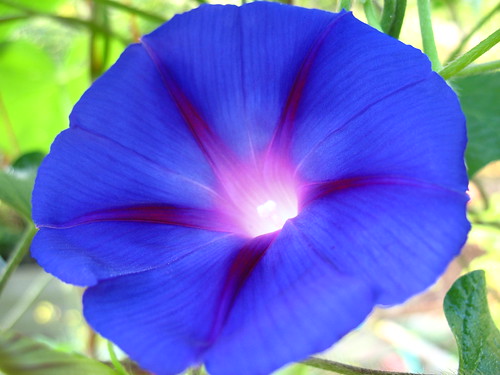
This is not a blue petunia, it is a morning glory.
Screen shot from NY Times website, Jan 6, 2014, by BotanicalAccuracy.com

Now, the only problem is that this is not a petunia. Petunias are members of the genus Petunia (simple!) in the Solanaceae, the potato family. This is unfortunately a photo of a morning glory, in the genus Ipomoea in the family Convolvulaceae, related to sweet potatoes. There are several kinds of morning glories, all in the same family, and both morning glories and petunias come in a wide array of flower color patterns.

The very interesting research  article has the right plant in its illustrations.
Illustration showing the mutation that causes blue petunias.
Image (c) Faraco et al. (2014) [Cell reports 10.1016/j.celrep.2013.12.009]
How could this happen in a  news article? Well, I guess someone at The New York Times did a stock photo search for petunia and found a nice photo, used it, and didn't realized it was mislabeled. Stock photo archives are full of mislabeled plants. So you pay for a photo, and then it turns out to show the wrong plant - not really what you paid for. Here is the source at iStock by Getty images:

The source of the wrong petunia image.
Screen shot from iStock by Getty Images website, Jan 6, 2014, by BotanicalAccuracy.com
Now, how do you tell a petunia from a morning glory? There are a couple of differences. Morning glories usually have heart-shaped leaves (like the ones on the photo above). Petunias have smaller, hairy oval-shaped leaves. Morning glories are climbers that twist their stem around something to climb higher and higher. Petunias grow like little bushy herbs, no climbing and twisting in them. The colorful petals are fused in both species into a giant flaring trumpet (the corolla) and can look similar, but the edge of the corolla is mostly even in morning glories, but uneven and notched in petunias.

Here is a petunia:
Petunia flower.
Public domain photo by Zirguezi.
Here is a morning glory:

Morning glories (Ipomoea sp., Convolvulaceae)
Blue morning glory flower.
(cc) Vilseskogen on Flickr.
[Thanks to BA for notifying me about this mistake. The New York Times have been notified.]

UPDATE 1: It seems that the wrong photo was first used by the renowned science magazine Science [!!!] in their highlight of this research.  See their article titled "ScienceShot: Broken Pump turns petunias blue", dated Jan 2, 2014. So The New York Times probably just reused the photo provide by Science. Here is the screenshot:

The first use of the wrong petunia image, in Science.
Screenshot from Science Magazine, on Jan 5, 2014, by BotanicalAccuracy.com
UPDATE 2: International Science Times picked a new photo for their article about this research, and again, a morning glory is on the photo, not a petunia. Screenshot below:

Another morning glory presented as a petunia.
Screenshot from International Business Times website, Jan 7, 2014, by BotanicalAccuracy.com.
UPDATE 3: Science fixed the photo error within a few hours of being notified, and now display petunias with their article.  Excellent! Here is the new photo, provided by the authors of the research study, Francesca Quattrocchio and Ronald Koes. 

A new photo with abundant and correct petunias on the corrected Science web page.
Screenshot from Science magazine website, Jan 9, 2014, by BotanicalAccuracy.com
UPDATE 4: Some other media organizations and companies got it right from the beginning.  Kudos to International Business Times, NBC News, Discover Magazine, Headlines and Global News.

UPDATE 5: New York Times removed the photo for their article and provided a correction on Jan 10, 2014. Thank you!

Friday, January 3, 2014

What is in the herbal medicine? Maybe not what you think

Billions of dollars are spent on herbal supplements every year by people in the US. We buy our capsules with powders inside, dried roots, leaves, or flowers for teas, and powders to take as supplementary medicines or as health agents.  At the time the plant is in the tea bag, dried or a powder, it is no longer easy to identify it. But you can use its DNA to check its DNA barcode against a database of known, correct DNA barcodes for common medicinal plants.

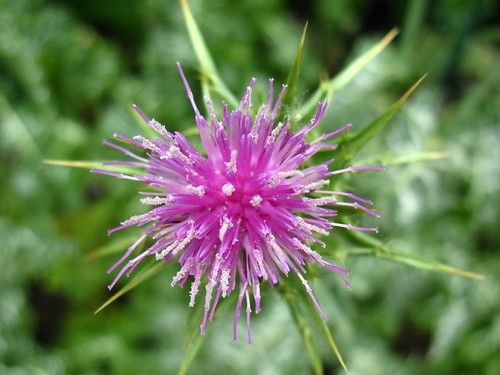
Italian Renaissance garden: milk thistle (Silybium sp., Asteraceae)
Milk thistle, Silybum sp. (cc) Vilseskogen on Flickr.
That is what a group of Canadian scientists led by Steven Newmaster did (see research article).  A recent article in New York Times (Nov 5, 2013) describes how they bought a large sample of herbal supplements, and then sequenced the DNA inside each product to see if the label matched the content.  They also sequenced the real medicinal plants to build up a database of correct DNA barcodes to use  as a reference database.  This is all high-tech but also standard scientific practice work these days.
(Here is a good introduction to DNA barcoding.)

In about 60% of cases, the plants did not match the label. This is remarkable.  Imagine if the same kind of product fraud existed in the spice rack, at the meat counter, at the pharmacy, or when you buy garden bulbs.
"Sorry, your narcissus was a daylily!" 
"No wonder that beef tasted strange, it was frozen elephant meat."  
"Aspirin, cornstarch, or tylenol, no problem!"  
Why do we accept this for herbal products and from these health companies?

Is your herbal product from the right species?  Probably not. 
In this analysis of 12 herbal products, only 2 had exactly the right species (green bars).
Brown bars indicate the wrong species (with dark brown being inactive filler species).
(c) New York Times, Nov 5, 2013 (link)
Now this is scary.  Not only is this false marketing, but this can also be dangerous for people that have allergies to certain species and their compounds.  Also of great concern is if the producer of these products actually knows what is in their pills. What do you think? Are these inadvertent mistakes, or made on purpose, where they diluted the active plant with cheaper similar or inactive plant materials?

The producers often buy their plant ingredients from commercial suppliers, and they trust the supplier to know what each plant is.  Sometimes, even the supplier companies buy from a third party, the collector or grower of the plant somewhere in the world, and they just assume the plant is correct.  Considering how hard it is sometimes to identify a plant, especially in its ground and/or dried state, it might not be that strange that mistakes are happening.  But, that is not acceptable.

So, if you want to buy an herbal product, how do you know you get the safest and best one?  Well, you probably will never be totally sure.  Look for companies that provides standardized doses, that are reputable, and do not buy the cheapest stuff on ebay.  Ask the company who their suppliers are, and how they ensure the taxonomic accuracy of their products.  If they can't answer, well, then you have your answer. 

The Newmaster article states:
"Most of the herbal products tested were of poor quality, including considerable product substitution, contamination and use of fillers. These activities dilute the effectiveness of otherwise useful remedies, lowering the perceived value of all related products because of a lack of consumer confidence in them. We suggest that the herbal industry should embrace DNA barcoding for authenticating herbal products through testing of raw materials used in manufacturing products. "
I totally agree.  "Dear companies, please prove to your consumers that you put in the plant that you charge for.  Please list all ingredients.  It would also be helpful if you can standardize the doses of the active compounds in your product.  While you are at it, also make sure you include scientific names, and list the provenance (geographic origin) of your plant supplies."  After all, isn't that the least we can ask for?  They are starting to use DNA bar codes to check the fish species served on restaurant plates, and we demand the same for other sold products like herbals used in alternative medicine.

A herbalist that uses local plants is often much more knowledgeable about the plant species than the commercial companies, collects the plants herself/himself, and provides a local, small-scale product that is more likely to have the right species in it than one that you buy from a shelf.  That said, it is harder for a herbalist to know exactly how strong the doses is in the final product, since that usually takes some chemical analysis.  

Sources:
DNA barcoding detects contamination and substitution in North American herbal products by Newmaster et al., 2013, BMC Medicine 11:222; doi:10.1186/1741-7015-11-222

Saturday, December 28, 2013

Batman and Poison Ivy's leaves

The weeds and botanical inaccuracies have also entered the world of comics. In 1966, Batman had a new nemesis, Poison Ivy, a botanist turned bad. (Brilliant!, says the botanist and author of this blog.) The poison ivy plant is one of the most obnoxious weeds of North America.
Issue 181 of DC comics Batman, introducing Poison Ivy for the first time (1966).
The leaves are very similar to true poison ivy, and definitely not English ivy leaves.
© DC Comics, fair use, Wikipedia.
"Poison Ivy is an enemy of Batman. She is depicted as one of the world's most prominent eco-terrorists. She is obsessed with plants, botany, and environmentalism. She uses toxins from plants and her own bloodstream for her criminal activities, which are usually aimed at protecting the natural environment." 
(link to this quote and more information about Poison Ivy at Batman Wiki)
Poison Ivy is of course named after one of North America's most troublesome weeds, the poison ivy (Toxicodendron radicans) in the family Anacardiaceae, same family as the tasty cashew nut and mango, as well as poison oak and poison sumac. This incredibly common woody plant, which can be a shrub or a liana, can cause absolutely horrible allergic dermatitis (skin reaction) with liquid-filled blisters and sores that can take weeks to heal. I know this first hand; I became allergic after moving to the US.

What is interesting with Batman's Poison Ivy is her leafy coverage, which has changed over the years.  Now, remember, most Americans know how poison ivy looks like, 'leaves in three, leave them be'.  In reality the three 'leaves' all belong to the same leaf, which is divided into three separate leaflets.
Poison ivy, leaves are divided into three separate leaflets,
with the middle leaflet stalked. Do not touch this plant!
Photo by Esculpio, public domain, link


But there is a sort of namesake, English (and Irish) ivy (Hedera helix and H. hibernica), which is an unrelated, non-allergenic European plant that has spread through horticulture across North America.  English ivy has simple leaves with three lobes.  Since the common names are similar, and both have green leaves and are climbing, people confuse these plants.

English ivy, with non-divided but lobed leaves. 
Photo by James H. Miller, USDA Forest Service, public domain, link
The subsequent illustrators of Batman's Poison Ivy girl has not always been able to make the distinction between poison ivy and English ivy, and as a result, there is a lot of confusion, especially among non-DC comics people making illustrations, costumes, and such when it comes to the right leaf to draw or use.   

Now, why is this important?  Well, accessorizing Poison Ivy with the wrong plant is kind of giving Luke Skywalker a sunflower to fight with instead of a lightsaber.  One is powerful and strong, the other is just pretty. We are not talking imaginary futuristic plants here, we are talking about living, existing species.  Nobody would name a character 'Lord Bear' and then let him wear a deer skull on his head, now would they? The same thing should matter for plants, especially toxic plants.


So, lets see who got it right? These are true poison ivy leaves.
1966, with correct leaves on.
(c) DC Comics, fair use, link.


Poison ivy on the cover of Joker's Asylum issue 1, 2008 (by DC Comics).
A little hard to tell on this, but there are three-divided leaves on the brown branch at the bottom
right and the leaves do not look like English Ivy at all.
(c) DC Comics, fair use, link
A closeup of above illustration.
Source, see above.
Poison Ivy in 1981, also with right leaves on.
© DC Comics, fair use, drawn by Irv Novick and Steve Mitchell, link.

And in the last ten years, things started to go wrong.
Here we have sometimes English ivy instead of Poison Ivy.

The leaves are clearly broad and have three lobes, so English ivy it is.
Promotional art for Batman: Gotham Knights vol. 15 (2001). Illustration by Brian Bolland.
Close-up below. © DC Comics, fair use, link.
English ivy, definitely.
(source, see full image above)
English ivy leaves on Poison Ivy.
© DC Comics (DC Universe online), fair use, link.

9
English ivy abounds on Poison Ivy here.
© DC Comics, fair use, link.

If you are going to buy a Poison Ivy Halloween costume (for $300),
do you want it with English ivy leaves?  Here is one of them.
Screenshot from etsy, © darkpony designs, fair use, link.
 And some are just using some generic leaves, of uncertain species identities or are just unclear:

Poison Ivy in a DC comics from 2006, with leaves in her hair. Closeups below.
© DC Comics, fair use, link.
On the upper frame, she appears to have true poison ivy in her hair.
But on the bottom right frame the leaves suddenly have become more lobed. 
This still possibly could be poison ivy, but it is not typical shapes at all. Looks more like English ivy now.
 And, if you want to simplify, just remove all leaves and
then you don't have to worry about species identity:

Poison Ivy in the animated Batman movies.
© DC Comics, fair use, link.

Tuesday, December 24, 2013

What Christmas tree is that? A guide to common species

Christmas trees come in many shapes, colors, and species these days.  In the old days you went out into the forest and cut a little (usually rather scraggly-looking) tree of some native tree in your local forests.
Postage stamp from ร…land (between Sweden and Finland) showing people
(with saw in hand) bringing home the Christmas tree.
(c) Posten ร…land, fair use (link)
For example, in Northern Europe you have only one local species of pine (Scots Pine, Pinus sylvestris), and only one spruce species (Norway Spruce, Picea abies), so a wildcut tree would be one of those species. Unless you brought in a juniper of course (Juniperus communis). In North America there are more local conifers to choose from, but still mostly only a handful.  But these days things are not so simple.

Nowadays, the Christmas tree plantations grow a wide variety of conifer species that might not be local to your area. If you get a tree from a supplier, then the tree might come from far away.  So, finding out what tree you have standing in your living room might not be that simple.

The National Christmas Tree Association has nice photos and descriptions of the most common species. Brooklyn Botanic Garden also has a great clickable key to Christmas tree species with images and descriptions of 15 common species. (Update: Max Payne also has a nice page with descriptions of common Christmas tree species, including several Cupressaceae species.)

First, most Christmas trees are either FIRS (Abies), SPRUCES (Picea), DOUGLAS FIR (Pseudotsuga). or PINES (Pinus). All of these are conifers and have leaves called needles, and cones (except, you rarely see cones on young trees used for Christmas). These plants are quite easy to tell apart and they all belong to the pine family, Pinaceae. See key below.
US Postal stamps showing balsam fir, blue spruce, ponderosa pine and eastern red cedar.
(c) USPS, fair use (link)
Identification key to common Christmas tree genera
1a. Are the needles clustered 2-5 together? Yes - it is a pine (Pinus).
1b. Are needles single? Yes - it is a fir, douglas fir, or spruce. Go to 2.  
2a. Are the needles square in cross-section and green underneath? Yes - it is a spruce (Picea).
2b. Are the needles flat in cross-section and have two white bands underneath? Yes - it is a fir or douglas fir. Go to 3.

3a. The buds at the end of each branch have a sharp tip and are elongated. Yes - it is a douglas fir (Pseudotsuga).
3b. The buds at the end of each branch are blunt at the apex and round. Yes - it is a fir (Abies).
White pine.
Public domain image by Hardyplants, Wikipedia.
PINES (needles grouped in 2-5's)
Needles 5 together: 
  • White pine (Pinus strobus) - green to bluish green, needles 5 together, 5-12 (2-4") cm long
Needles 2 together:
  • Scots pine [older name: Scotch pine] (Pinus sylvestris) - green, sometimes silvery, needles 2 together, 4-7 cm (2-3") long
  • Virginia pine (Pinus virginiana) - green to yellowish green, needles 2 together, 4-7 cm (2-3") long
Norway spruce branch.
(cc) Wikipedi, Wikipedia.
SPRUCES (needles single, square in cross-section, no white bands below each needle; each needle attached to the branch on a little outgrowth; needles attached spirally around branch)

Bluish or greyish tree
  • Colorado blue spruce (Picea pungens) - blue green, needles 2-3.5 cm (1-1 1/4") long, with sharp tip
  • White spruce (Picea glauca) - bluish to bluish green or gray, needles 1-2 cm (3/8-3/4") long, with blunt tip
Green tree
  • Norway spruce (Picea abies) - dark green, needles 1-2.5 cm (1/2-1") long (drooping branches)
Douglas fir branch with cones. The cones are unique,
look at those bracts hanging out betweenthe scales, nothing else looks like that.
(cc) Walter Siegmund, Wikipedia.
DOUGLAS-FIR (needles single, white bands below each needle)
  • Douglas-Fir (Pseudotsuga menziesii) - green to blue green, needles soft, 2-4 cm (3/4-1 1/4") long
Needles of White Fir showing white lines underneath.
(cc) Walter Siegmund, Wikipedia.
FIRS (needles single, flattened; white bands below each needle; each needles attached directly to the branch; needles attached in two rows along branch)

Needles with two white lines above
  • Concolor Fir [White Fir] (Abies concolor) - green to bluish green, needles 2-5 cm (1 1/4-2") long (needles with sharp apices)
  •  Caucasian Fir ["Nordmann"] (Abies nordmanniana) -  dark green, needles 1.8–3.5 cm (2/3-1 1/2")
Needles green or silvery above, without lines
  • Balsam Fir (Abies balsamea) - dark green, needles 1-4 cm (3/8-1 1/2") long (needles with blunt, notched apex)
  • Fraser Fir (Abies fraseri) - silvery to dark blue green, needles 1-2 cm (1/2-1") long (twigs with red hairs)
  • Grand Fir (Abies grandis) - green, needles 2-5 (1/2-2") cm long (twigs with grey hairs, needles with blunt, notched apex)
  • Noble Fir (Abies procera) - silvery, needles 2-4 cm (1-1 1/2) inches long (needles turn upwards along branches)
(Not included in this blog post are cedars, junipers, and yew, since they are less common as Christmas trees.)
Post updated 28 January 2014 with new information provided by MF.

Sunday, December 15, 2013

Christmas Tree of Life does not need a little correction

Christmas Tree of Life Greeting Card
(c) blaghag on Zazzle, fair use.
Here is a cute little Christmas Tree of Life Greeting card designed by 'blaghag' for sale on Zazzle (link) , depicting the evolutionary relationships between reindeer, elves, Santa, and the four plants fir tree, poinsettia, holly and mistletoe, all accurately depicted and with nice scientific names.  Santa and the elves got new fictitious scientific names, nice! The description of the card includes this justification why this is a great card to buy:
"From mistletoe to reindeer, we're all share a common ancestor! Great card to send to your scientific and freethinking friends for the holidays."
I love this card.  It is innovative, fun, and for any science and reason-minded person, a great card.

Phylogenetic trees are read from the root to the tips. In this card, the root (the common ancestor) is at the top, and the branches to the different organisms are branching downwards.  Santa is most closely related to Elves, and reindeers are related to Santa+Elves, since they are all animals, all three of these groups.

Fir trees are conifers, and conifers are part of gymnosperms that are the sister branch/group to flowering plants (such as poinsettia, holly, and mistletoes).  Poinsettia is in the family Euphorbiaceae with spurges and they are placed in a bog group of plants called rosids (near roses, walnuts, birches, and many other plants). Mistletoes are in the family Santalaceae with lots of other parasitic plants, which are placed on another branch, sister to a giant group of plants called asterids.  Holly, an asterid, is in the family Aquifoliaceae. Other asterids are carrots, sunflowers, viburnum, and artichokes, the coffee plant, milkweeds, mint and potatoes.

[This post was updated on January 12, 2014.  The phylogenetic tree shown on the postcard is correct; mistletoes are sisters to holly plants.  The blog text has been changed so it is accurate based on the latest scientific findings. We regret the error. ]

Saturday, December 14, 2013

Holly, a winter holiday plant without much need for correction

It is holiday season and we are surrounded by red and green plants that have come to symbolize the Christmas season.

One of the most common is the holly, Ilex aquifolium, I. opaca and related species, in the Aquifoliaceae.  With its dark green, evergreen, spine-tipped and lobed leaves paired with round red berries, it is largely unmistakable and easy to identify and remember. 
European holly, Ilex aquifolium. Plate from Atlas des plantes de France (1891).
Public domain image (Wikimedia). 
It is also really easy to draw, red circles for the berries and lobed, spiny leaves in green.  This is probably the reason this is one of the plants where you find the fewest mistakes when it is depicted as a visual image.

So, for a change, presented here is an example of persistent botanical accuracy, not inaccuracy.  A  Google Image search pulls up hundreds of true holly images, despite a large variety in artistic design and media; here are just one example of a screen shot:

Screenshot of the results of a Google search for 'holly', by BotanicalAccuracy.com

Saturday, December 7, 2013

A jasmine is not always a jasmine...

Jasmine (Jasminum) is a wonderfully and strongly scented flowering plant in the olive family (Oleaceae) and its essential oil has been used for millenia as a perfume.  Jasmine flowers are usually white, have five to ten petals and always two stamens in each flower, and they are often hidden in a narrow corolla tube. The plants grow as viny shrubs.  Having only two stamens is a character that is consistent for all olive family members, like olive (of course), lilacs, fringe trees, and goldenbells - and jasmine.  A few jasmine mutant cultivars have filled flowers, so they have more petals of course.
Typical jasmine flower (Jasminum).
(cc) KENSEI on Wikipedia

The problem is that there is a similar genus, mock orange (Philadelphus), which also have white, 4-petaled flowers, and is gorgeously scented.  This commonly cultivated garden shrub is not in the olive family, but in the hydrangea family (Hydrangeaceae), and have lots and lots of stamens inside each flower. The stamens are the yellow 'fluff' in the center of each flower in the photo below.   In Swedish, the common name for mock orange is 'schersmin', and in English it is called 'false jasmine' obviously influenced by the true jasmine and similar scent and flower color.
Typical mock orange flower (Philadelphus).
(cc) Epibase on Wikipedia
So jasmine and mock orange are really easy to tell apart, and they are not closely related plants, but they still get mixed up over and over on food, cosmetics and other product labels.  True jasmine is commonly used in cosmetics and should be listed as various Jasminum extracts and oils on the ingredient label according to the INCI database. Philadelphus flower extract is also approved as an INCI-listed ingredient and used as skin conditioning agent, but it is not listed as 'jasmine' or similar in INCI. So generally speaking, if something smells nice and is called jasmine-something, then it should include Jasminum and have a picture of Jasminum on it, not Philadelphus.  Unfortunately, this is not always the case.

What really is scary is when the producers and sellers of the raw extracts and compounds don't know how to identify the images they use to promote their raw materials sold wholesale to other companies.  M K Exports India sells 'jasmine oil', and illustrates it with this inaccurate figure:


Jasmine oil illustrated with the wrong flowers - the flowers are from mock orange.
Screenshot from M K Exports India's website, by BotanicalAccuracy.com.

Here are some more examples of inaccuracies on labels and in advertising:
Jasmine perfume by Taylor of London, showing Philadelphus flowers, not jasmine.
© Taylor of London, fair use (link)


Home Scents sells a candle named 'jasmine bouquet', with Philadelphus on the label.
© Home Scents, fair use (link)
Tea fortรฉ's Jasmine green tea is illustrated with Philadelphus too.
(c) Tea fortรฉ, fair use (link)
I also think the Rock Art Brewery's Jasmine Pale Ale Beer from Vermont has Jasminum in it, and not Philadelphus, but it is hard to know for sure. On the outside label is a Philadelphus flower.

Livestrong.com has a web page on the health benefits of jasmine tea, with a stock photo showing a tea cup with, you guessed it, Philadelphus flowers.
Livestrong's web page on jasmine shows mock orange too.
Screenshot from Livestrong.com by BotanicalAccuracy.com


Some companies get it right, of course:
Mark: Jasmine Petals Get Misty Body Mist (with real jasmine flowers)
© Mark, fair use (link)
Yankee Candle's Blooming Jasmine candle has real jasmine on the label.
© Yankee Candle, fair use (link)
So, the two genera Philadelphus and Jasminus are really easy to tell apart even from small photos, but it is obvious that companies and photographers mixed them up.  Both are gorgeous garden or house plants, so it is well-worth to learn the difference between the two.

Thursday, December 5, 2013

Canola oil flowers - four or five petals? Ask Trader Joe...


Canola oil is made from the rape seed plant's (several Brassica species) oil rich seeds, a member of the mustard family, the Brassicaceae.  Members of this family can easily be identified by their very typical flowers.  They have 4 petals, often white, yellow, or pink, situated in a cross-wise fashion, which gave them the old family name Cruciferae.  Yes, that is the same word beginning as in crucifix, a cross.

Brassicaceae flowers also have 6 stamens, and a central pistil that will develop into a fruit when/if pollinated.  All mustard plants have the same types of flowers, be it broccoli, garlic mustard, cabbage, arugula, or kohlrabi.  But there is one place, where the rule doesn't hold up...

Canola Oil Spray at Trader Joe's.
(cc) BotanicalAccuracy.com

On the Trader Joe's Canola Oil Spray bottle, sold only at the Trader Joe's supermarket, they have nicely added some flowers from the canola oil plant to the label. Only the flowers look like this:

Close up of Canola Oil Spray cans at Trader Joe's.
(cc) BotanicalAccuracy.com


So, what do we have here?  One flower with four petals (good!), and one flower with five petals (oops!).  And inside each flower, there are three 'things'.   I assume these might be stamens or pistils, but neither makes sense based on the numbers or shapes. The flowers are also never arranged in this particular fashion, but that is a minor point.

So, who cares? Well, if you make a piece of art you certainly can and should have artistic freedom. But, if you illustrate a product, the illustration should provide some knowledge (or excitement) or identification value about the product. It should be the real thing and not introduce errors or misunderstandings into the public's knowledge of plants and the product source.

The number of petals on mustard flowers are strictly determined by that group's bauplan, just like the 4 legs of a dog is based on a strict bauplan among allmammals. You don't go around and see a 5-legged dogs, do you? (5-legged dogs do exist, but are mutants, and they are even rarer in art.)

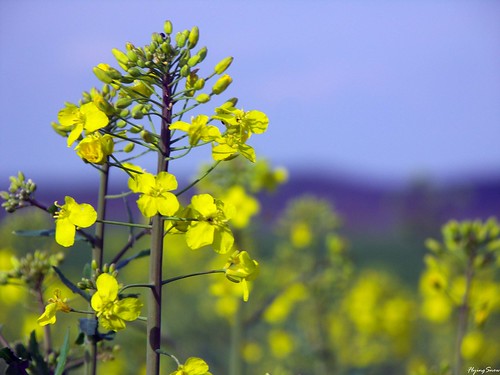
Here is the real canola:
canola
Flowering canola plant. 
(cc)  Melanie_B (Flying Snow) on Flickr.

So, in this case, the flowers on the label are used to illustrated the origin of a product, canola oil from the canola plant. There are no canola oil flowers with 5 petals. There are no canola oil flowers with 3 non-descript things in the center of the flowers.  If this drawing had been made with 4 petals it would have been equally pretty, and also accurate. So you start to wonder where things went wrong, with the illustrator, with the description to the illustrator, or to the designer of the label?